










Dry Weather Continues Through Friday As Rain Chances Increase For Halloween Weekend

Chattooga County residents can expect several more days of dry, pleasant fall weather before rain chances return just in time for Halloween weekend.
According to the National Weather Service in Peachtree City, high pressure will continue to dominate the weather pattern across Northwest Georgia through Friday, bringing sunshine, mild afternoon temperatures and cool nights.
Tuesday, October 27, will be sunny with a high near 75 degrees. Winds will be calm throughout the day. Tuesday night will be partly cloudy, with temperatures dropping to around 48 degrees.
Wednesday will bring partly sunny skies and a high near 74 degrees. Thursday will be sunny with a high around 77, followed by mostly sunny skies Friday and a high near 78 degrees.
Overnight temperatures will generally remain in the upper 40s to middle 50s through the end of the workweek.
Forecasters say the continued dry conditions are the result of a large area of high pressure that has kept significant rainfall away from North and Central Georgia.
While the lack of rain has contributed to increasingly dry conditions across the region, the National Weather Service says moisture moving inland from the Atlantic Ocean should help keep humidity levels above critical fire danger thresholds during the week.
The biggest question in the forecast involves Halloween on Saturday, October 31.
After several days of sunshine, clouds are expected to increase Saturday, with a 20 percent chance of showers developing after 2 p.m. The afternoon high will be near 75 degrees.
Rain chances will increase to 40 percent Saturday night, when temperatures are expected to fall to around 58 degrees.
The possibility of rain could affect Halloween walks, trunk-or-treat celebrations and other outdoor activities planned throughout Chattooga County.
However, National Weather Service forecasters emphasize that considerable uncertainty remains about the timing and development of the approaching weather system.
Some forecast models suggest showers could develop Saturday afternoon or evening, while others indicate the better chance of rainfall may hold off until Sunday.
Sunday, November 1, currently carries a 50 percent chance of showers, with mostly cloudy skies and a high near 72 degrees.
By Monday, November 2, rain chances are expected to decrease to around 20 percent, with partly sunny skies and a high near 77.
For now, residents planning Halloween activities should keep an eye on updated forecasts throughout the week.
The National Weather Service says the overall pattern will remain dry and seasonably mild through Friday, but the approaching weekend could finally bring some much-needed rainfall to Northwest Georgia.
Summerville Police Investigating Alleged Forged Checks Totaling Nearly $5,000

The Summerville Police Department is investigating a reported forgery involving two canceled business checks totaling nearly $5,000 that were allegedly altered and deposited without authorization.
According to a report filed with the Summerville Police Department, Officer Vitality Labs responded to 170 Vitality Lane in Summerville, where Melissa Hamilton, an officer and representative of the company, reported discovering two checks bearing the business’s name that had been manufactured.
Hamilton provided police with copies of two canceled checks, numbered 5927 and 5928, totaling $2,459.75.
The checks appeared to contain Hamilton’s signature, but she told police the signature had not been authorized and had been falsely applied to the checks.
Hamilton also presented the original blank checks that had been recovered from the company’s checkbook, indicating the fraudulent checks had been created using the company’s banking information.
Hamilton advised police that the company’s bank had reimbursed the fraudulent withdrawals but required a police report documenting the incident.
The case remains under investigation by the Summerville Police Department.
Trion Man Indicted On DUI And Fleeing Charges Following Police Pursuit

A Trion man arrested earlier this year following an alleged DUI incident and police pursuit on Old Highway 27 has been indicted by the Chattooga County Grand Jury.
Brandon Zane Tibbs, 2541 Old Highway 27, Trion, was indicted this month on charges of DUI, second-degree criminal damage to property, felony fleeing police, reckless driving and five other traffic offenses.
Tibbs was arrested on February 28, 2026, following an incident that led to multiple traffic-related charges.
The original arrest included allegations of driving under the influence of alcohol, reckless driving, attempting to flee or elude law enforcement, and several additional traffic violations.
The October indictment moves the case forward in the court system, where Tibbs will have an opportunity to answer the charges.
An indictment is a formal accusation and does not constitute a finding of guilt. Tibbs is presumed innocent unless proven guilty in court.
Trion Plans To Replace Fire Truck Destroyed In Fire At Mount Vernon Mills

The Town of Trion is making plans to purchase a new fire truck after one of its trucks was destroyed in a fire at the Mount Vernon Mills firehouse earlier this year.
Trion Mayor Mickey McGraw said the town recently received a $329,000 insurance payment for the destroyed truck. However, that money is expected to cover only about half the cost of purchasing a replacement.
“That will cover about half the cost of a new one,” McGraw said.
The fire occurred this summer inside the firehouse located at Mount Vernon Mills. A passerby noticed smoke coming from the building and alerted authorities.
Officials believe faulty wiring may have caused the blaze. Although the fire started inside the building, the mill itself was not damaged.
The destroyed fire truck was a Rosenbauer purchased from Southern Emergency Products Inc. in 2012 for approximately $330,000. According to McGraw, the cost of fire trucks has doubled since that purchase.
The town plans to purchase a replacement truck and sell one of its older trucks, which remains operational.
In the meantime, neighboring fire departments are providing fire protection coverage for Trion.
Georgia Gas Prices Drop Eight Cents As Chattooga County Drivers Pay $3.60 Per Gallon

Georgia motorists are seeing some relief at the gas pump as prices continue to decline, with the statewide average falling eight cents over the past week. Drivers in Chattooga County are paying slightly less than the state average, according to the latest figures from AAA – The Auto Club Group.
As of Monday, October 26, the average price for regular unleaded gasoline in Georgia stands at $3.65 per gallon, down from $3.73 a week ago. Prices have fallen 51 cents over the past month but remain 86 cents higher than this time last year.
In Chattooga County, the average price is $3.60 per gallon, five cents below the statewide average.
AAA reports that the suspension of Georgia’s state gasoline tax, the transition to less expensive winter-blend gasoline and reduced seasonal travel demand are helping bring prices down. However, crude oil prices above $100 per barrel continue to limit how much motorists are saving.
“Georgians are seeing some relief at the pump, with prices averaging 63 cents below the national average,” said Montrae Waiters, spokeswoman for AAA – The Auto Club Group. “While seasonal factors are helping push prices lower, drivers can save even more by comparing prices, using fuel rewards and combining errands.”
Gas Prices Across Northwest Georgia And Northeast Alabama
The latest county averages for regular unleaded gasoline include:
- Chattooga County: $3.60
- Walker County: $3.58
- Floyd County: $3.59
- Gordon County: $3.60
- DeKalb County, Alabama: $3.77
- Cherokee County, Alabama: $3.70
Across Georgia, the most expensive metropolitan markets include Savannah at $3.70, Atlanta at $3.68 and Gainesville at $3.67.
The least expensive markets include Warner Robins at $3.58, Brunswick at $3.52 and Albany at $3.46.
National Prices Remain Above Four Dollars
The national average for regular gasoline stands at $4.28 per gallon, down just one cent over the past week.
AAA says higher crude oil prices are slowing the decline in gasoline costs nationwide. October is on track to become the most expensive October on record for the national average, following record-setting gasoline prices in August and September.
For Georgia motorists, filling a standard 15-gallon tank at the statewide average costs approximately $54.75. In Chattooga County, that same fill-up costs about $54.
AAA recommends comparing prices at different stations, using fuel rewards programs, combining errands and avoiding aggressive driving to help reduce fuel expenses.
Gasoline prices are subject to daily changes.
Halloween Safety Takes Center Stage As Rain Chances Increase For Weekend Activities

Halloween is just days away, and families across Chattooga County are preparing for a weekend filled with costumes, candy, trick-or-treating, hayrides and community celebrations. With activities planned in Summerville, Trion, Menlo, Lyerly and at James H. “Sloppy” Floyd State Park, residents are encouraged to keep safety in mind, especially as the forecast now includes the possibility of rain on Halloween night.
Halloween falls on Saturday, October 31, this year, and the National Weather Service says the weather could become unsettled just in time for the holiday.
Saturday’s forecast calls for partly sunny skies with a high near 75 degrees and a 20 percent chance of showers. Rain chances increase to 50 percent Saturday night, with showers and thunderstorms possible. Forecasters say the timing remains uncertain, meaning some Halloween activities could stay dry while others may be affected by rain.
Halloween Activities Across Chattooga County
Several communities have celebrations planned for families and children.
In Summerville, Pumpkin Palooza will take place Saturday from 10:30 a.m. until 3 p.m. in the historic Summerville Depot area, featuring food and craft vendors. The downtown Halloween Walk is scheduled from 10:30 a.m. until 12:30 p.m. along the East Washington Street Streetscape, with a costume contest beginning at 11:30 a.m. at the Open Air Stage.
Trion’s annual Halloween Walk is scheduled to begin Saturday evening at 5:30.
In Lyerly, the Fire Department will host Trunk or Treat at Lyerly Park Saturday from 5 until 7 p.m. The event will include free hot dogs, followed by an outdoor movie beginning at 7:30 p.m. Families are encouraged to bring blankets or lawn chairs, and concessions will be available for purchase.
Menlo will hold its Halloween Walk on Friday, October 30, from 5 until 6:30 p.m. at Menlo Park.
Halloween Hayrides Return To Sloppy Floyd State Park
Families will have one final opportunity to enjoy the annual Halloween Hayrides at James H. “Sloppy” Floyd State Park near Summerville on Saturday, October 31.
The Friends of Sloppy Floyd will host the event from 1 until 4 p.m., offering family-friendly hayrides through the park during the fall season.
Admission is $5 for adults and $3 for children ages 5 through 12. Children ages 4 and younger are admitted free.
Visitors can also enjoy free candy, temporary tattoos and popcorn.
A $10 vehicle parking pass is required to enter the state park, although visitors with an annual Georgia State Parks ParkPass will not need to purchase a daily pass.
Visitors should park at the park entrance, where a free shuttle will transport them to the hayride area.
Park officials say the hayrides will be canceled in the event of rain, making Saturday’s weather forecast especially important for families planning to attend.
James H. “Sloppy” Floyd State Park is located off Marble Springs Road near Summerville.
Safety Tips For Trick-Or-Treaters And Drivers
With large numbers of children expected to be walking through neighborhoods and attending community events, parents and motorists are encouraged to take extra precautions.
Parents should make sure young children are accompanied by a responsible adult and that older children travel in groups. Costumes should fit properly to prevent trips and falls, and reflective tape, glow sticks or flashlights can help make children more visible after dark.
Children should use sidewalks whenever possible, cross streets at intersections and avoid walking between parked vehicles.
Motorists are reminded to slow down in residential neighborhoods, watch carefully for children crossing streets and avoid distractions while driving.
Parents should also inspect Halloween candy before allowing children to eat it, particularly checking for damaged packaging and potential choking hazards.
Rain Could Create Additional Hazards
With showers and thunderstorms possible Saturday evening, families should consider bringing rain jackets and shoes with good traction.
Wet leaves, sidewalks and steps can become slippery, especially after dark. Drivers should allow additional stopping distance if roads become wet.
If thunderstorms develop, families should move indoors rather than continuing outdoor activities. Lightning can be dangerous even when heavy rain is not falling.
The National Weather Service says confidence in the exact timing of weekend rainfall remains limited, and the forecast could change as Saturday approaches.
Families attending Halloween celebrations are encouraged to check for weather-related schedule changes and stay informed through local announcements.
WZQZ Radio will continue providing weather updates and information about Halloween activities throughout Chattooga County as the weekend approaches.
Trion Lady Bulldogs Open State Softball Elite Eight Wednesday Against Irwin County

The Trion High School Lady Bulldogs are preparing for their second consecutive appearance in the Georgia High School Association Class A Softball Elite Eight, with their opening game scheduled for Wednesday, October 28, against Irwin County.
The Lady Bulldogs will take the field at 1:15 p.m. Wednesday at the South Commons Softball Complex in Columbus, Georgia, as they begin their pursuit of a state championship.
Trion earned its place among the final eight teams with an impressive sweep of Taylor County in the second round of the state playoffs on October 19.
The Lady Bulldogs defeated Taylor County 3-0 in the opening game behind a shutout pitching performance from Hartley Staton, who struck out nine batters. Trion then battled to a 5-4 victory in the second game to complete the sweep.
The victories were especially meaningful after Taylor County handed Trion its first loss at last year’s Elite Eight tournament.
Trion entered the second round after sweeping Atkinson County in the opening round, winning 11-1 and 17-5.
Head Coach Trent Stamey praised his players following the Taylor County series, saying the team had shown determination throughout the season and that their hard work had earned them another opportunity to compete for a state championship.
The state tournament runs Wednesday through Saturday, October 31, and features a double-elimination format, meaning teams must lose twice before being eliminated.
Fans planning to attend should know that tickets must be purchased online through GoFan. Tickets will not be sold at the gate.
All tournament games will also be available through the NFHS Network.
The Lady Bulldogs will be looking to continue their outstanding season Wednesday afternoon as they take on Irwin County in Columbus.
Dry Weather Continues Across Chattooga County As Fire Concerns Increase

The extended stretch of dry weather across Chattooga County and Northwest Georgia is expected to continue through the end of the workweek, with forecasters keeping an eye on conditions that could increase the danger of outdoor fires.
According to the National Weather Service in Peachtree City, high pressure will keep rain out of the forecast through Friday, bringing mostly sunny skies, mild afternoons and cool overnight temperatures.
For Tuesday, October 27, sunshine is expected across Chattooga County, with afternoon temperatures reaching the middle 70s. Overnight lows will fall into the middle 40s.
Similar conditions are expected Wednesday through Friday, with daytime highs generally in the 70s and little opportunity for rainfall.
The continuing dry weather is raising concerns about the possibility of fires spreading through dry grass, leaves and other vegetation.
National Weather Service fire weather forecasts indicate that afternoon humidity levels across Chattooga, Walker, Floyd, Gordon and surrounding counties could fall to between 30 and 35 percent Tuesday.
Although no fire weather warning was in effect when the forecast was issued, forecasters are monitoring the combination of dry air and the ongoing lack of rainfall.
Residents are encouraged to use caution with outdoor burning, properly extinguish cigarettes and avoid activities that could ignite dry leaves or grass. Anyone planning to burn outdoors should first check current restrictions and permit requirements.
The extended dry spell could finally see some relief as the weekend approaches.
Forecasters say rain chances will begin increasing Saturday, October 31, with a greater possibility of showers Saturday night and Sunday, November 1.
That timing could affect Halloween activities scheduled throughout Chattooga County, although the forecast remains subject to change as the weekend approaches.
Until then, residents can expect another stretch of pleasant fall afternoons, chilly mornings and very little chance of rain.
Georgia Reopens Home Energy Rebate Program Today
Georgia homeowners looking to make their homes more energy-efficient may qualify for financial assistance following the reopening of part of the state’s Home Energy Rebates program on Monday, October 26.
The Georgia Environmental Finance Authority reopened the Home Electrification and Appliance Rebates program with limited funding and revised eligibility requirements.
Under the program, qualifying homeowners can receive financial assistance for electrical wiring improvements and electrical panel upgrades when those improvements are part of an approved home energy-efficiency project.
Eligible households may receive up to $2,500 for electrical wiring improvements and up to $4,000 for electrical panel upgrades.
The amount of assistance available depends on household income.
Households earning less than 80 percent of their county’s area median income may qualify for rebates covering up to 100 percent of eligible costs, subject to program limits.
Households earning between 80 percent and less than 150 percent of the area median income may qualify for rebates covering up to 50 percent of eligible costs.
Households earning 150 percent or more of the area median income are not eligible for this particular rebate program, although other home energy assistance programs may be available.
The electrical improvements must be connected to an approved energy-efficiency project. Replacing an electrical panel or wiring by itself does not automatically qualify a homeowner for a rebate.
The application process begins with a home energy audit conducted by a program-approved contractor. The audit identifies potential improvements and helps determine which upgrades qualify for assistance.
The reopening applies to qualifying single-family homes. Multifamily and do-it-yourself application options are not reopening at this time.
For homeowners in Chattooga County and surrounding communities, the rebates could help reduce the expense of upgrading older homes, particularly when electrical improvements are needed as part of a larger energy-efficiency project.
Homeowners are encouraged to confirm their eligibility and work with an approved contractor before beginning improvements. Rebates are subject to available funding, and work completed before program approval generally does not qualify.
Residents can learn more about the program, review eligibility requirements and locate approved contractors at energyrebates.georgia.gov.
Additional information is available by calling 877-348-5237, Monday through Friday, from 9 a.m. until 6 p.m.
Trion Man Arrested Following Indictment On Child Molestation Charge

A 34-year-old Trion man with a previous sex offense conviction has been arrested following an indictment in connection with a child molestation allegation involving an 11-year-old child.
Christopher Glen Blackmon, of 210 Reed Street in Trion, was arrested on October 13, 2026, following an indictment stemming from an incident that allegedly occurred several months earlier.
According to Chattooga County Jail records, Blackmon was booked into the jail at approximately 9 p.m. on October 13 on a charge of child molestation.
The case stems from an investigation involving an alleged incident at Murphy’s convenience store, located at 13425 Highway 27, south of Trion.
Blackmon had previously been arrested on December 13, 2025, in connection with the same incident. The October arrest followed the indictment in that case and does not represent a separate child molestation allegation.
Blackmon, who has a previous sex offense conviction, now faces further court proceedings in connection with the charge.
A grand jury indictment is a formal accusation that allows a criminal case to proceed through the court system. It does not establish guilt.
Trion's Stacy Searels Inducted Into Georgia High School Football Hall Of Fame

Trion High School graduate and longtime college football coach Stacy Searels has received one of Georgia high school football’s highest honors.
Searels was inducted into the Georgia High School Football Hall of Fame on Saturday, October 24, during ceremonies at the College Football Hall of Fame in Atlanta.
A 1982 graduate of Trion High School, Searels was an All-State offensive lineman for the Bulldogs before continuing his football career at Auburn University.
At Auburn, Searels became one of the Southeastern Conference’s top offensive linemen. He was a three-year starter, earned first-team All-SEC honors in both 1986 and 1987, and was named a first-team All-American in 1987.
During his college career, Searels helped block for legendary Auburn running back Bo Jackson, who won the Heisman Trophy in 1985.
Searels was selected by the San Diego Chargers in the fourth round of the 1988 NFL Draft. He played professionally with the Chargers and Miami Dolphins before beginning a successful college coaching career.
His coaching career has included stops at Auburn, Appalachian State, Cincinnati, LSU, Georgia, Texas, Miami and North Carolina.
Searels returned to the University of Georgia in 2022 as offensive line coach under head coach Kirby Smart.
The Georgia High School Football Hall of Fame’s Class of 2026 includes 33 former players recognized for their contributions to high school football across the state.
For the Trion community, Searels’ induction adds another chapter to the Bulldogs’ long football tradition, recognizing a hometown athlete whose career took him from the high school football field in Trion to college football’s biggest stages.
Third Annual Turkey Trot 5K And Health Walk Set For November 14

Runners and walkers are invited to participate in the third annual Turkey Trot 5K Road Race and 2-Mile Health Walk on Saturday, November 14, 2026, an event organized by Eckroat Benefits Corporation in partnership with the Pregnancy Resource Center of Chattooga County.
The event will begin at 8 a.m. and offers participants two ways to get involved: a 5K road race for those who enjoy running and a two-mile health walk for individuals and families who prefer a more relaxed pace.
Now in its third year, the Turkey Trot brings together community members for a morning of physical activity, fellowship and support for a local organization.
The event is being held in partnership with the Pregnancy Resource Center of Chattooga County, which provides services and resources to individuals and families in the community.
Organizers are encouraging residents of all ages to participate, whether they are experienced runners, casual walkers or simply looking for an opportunity to enjoy a fall morning with friends and neighbors.
Those interested in participating can find registration information online at RunSignup.com by searching for the 2026 Turkey Trot.
The event’s theme, “Healthy Body, Strong Community, Thankful Heart,” reflects its focus on fitness, community involvement and giving thanks during the Thanksgiving season.
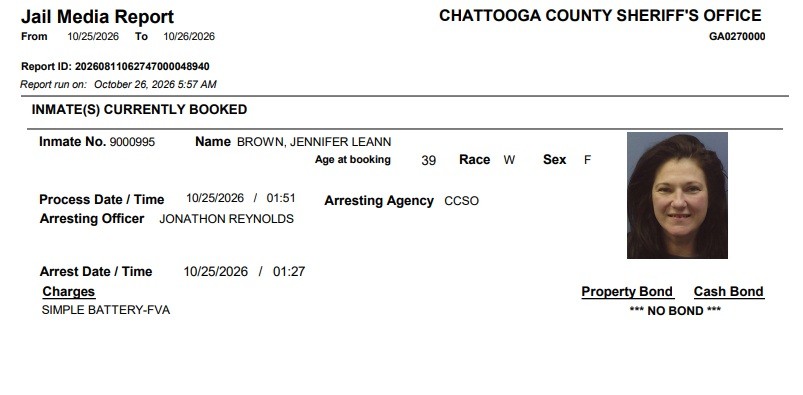
Arrest Report - Monday - October 26, 2026

Here is the latest arrest report from the Chattooga County Sheriff’s Office for Monday, October 26, 2026:
Dry And Mild Weather Continues Through Friday, Rain Chances Return For Halloween Weekend
Residents across Chattooga County and Northwest Georgia can expect another week of pleasant fall weather, with mostly sunny skies, comfortable afternoon temperatures and cool nights. However, the National Weather Service says rain chances will begin increasing over the Halloween weekend, potentially bringing the first significant change in the area’s weather pattern in some time.
Today, Monday, October 26, skies will be mostly sunny with an afternoon high near 72 degrees. Winds will be light, becoming easterly around 5 mph. Tonight will be partly cloudy with temperatures dropping to around 45 degrees.
Tuesday will bring more sunshine and a high near 75 degrees, followed by partly cloudy skies and a low around 47 Tuesday night.
The dry weather pattern will continue Wednesday through Friday. Wednesday will be partly sunny with a high near 74, while Thursday will feature sunshine and a high near 77. Friday will be mostly sunny and slightly warmer, with temperatures reaching around 78 degrees.
Forecasters say temperatures will remain near or slightly above seasonal averages throughout the workweek. The dry air will also keep humidity levels relatively low.
Halloween Weekend Could Bring Rain
The forecast becomes less certain heading into Saturday, October 31, when many families will be participating in Halloween activities.
Saturday is expected to be partly sunny with a high near 75 degrees and a 20 percent chance of showers. Rain chances increase to 50 percent Saturday night, with showers and thunderstorms possible and overnight temperatures around 57 degrees.
By Sunday, November 1, showers and thunderstorms are likely, with a 60 percent chance of precipitation and a high near 74 degrees.
The National Weather Service says the timing of the approaching weather system remains uncertain. Some forecast models suggest showers could develop Saturday afternoon or evening, while others indicate rain may hold off until later in the weekend.
For now, residents planning outdoor Halloween activities should keep an eye on updated forecasts as the weekend approaches.
Georgia To Launch New Statewide Teacher Job Search System In January

Finding teaching jobs in Georgia will soon become easier as the Georgia Department of Education prepares to launch an enhanced statewide educator job board in January 2027.
The Georgia Department of Education and the Georgia Professional Standards Commission are partnering to develop the new system through a collaboration between TeachGeorgia and Teach in the Peach.
The updated job board will provide a centralized location where teachers and other education professionals can search for employment opportunities throughout Georgia.
Job seekers will be able to search for available positions by location and receive alerts when openings matching their interests become available.
The system is also designed to help school districts recruit qualified educators by reaching a larger pool of potential applicants while reducing duplicate administrative work.
The new platform could benefit school systems across Northwest Georgia, including Chattooga County Schools and Trion City Schools, by making their available teaching positions easier for prospective employees to find.
State education officials say the improved job board is part of an effort to simplify the hiring process and better connect educators with employment opportunities throughout Georgia.
The enhanced statewide system is scheduled to launch in January 2027.
GNTC Graduation Letters Mailed To Summer And Fall Graduates

Georgia Northwestern Technical College is reminding students planning to participate in its December commencement ceremony that graduation letters have been mailed to summer and fall graduates.
College officials say the letters contain important instructions that graduates must follow and complete by Friday, November 6, in order to participate in the ceremony.
Students who submitted a graduation application for either the summer or fall semester but have not received their graduation letter are encouraged to contact the college as soon as possible.
Those students should email graduation@gntc.edu to notify college officials that their letter has not arrived.
Georgia Northwestern Technical College serves students throughout Northwest Georgia, including Chattooga County, through its campuses and educational programs.
Rising Child Care Costs Put Financial Pressure On Chattooga County Families

The rising cost of child care is creating financial challenges for working families across Georgia, including those in Chattooga County, where parents must balance the expense of caring for young children with the need to earn a living.
A report released in July by the Federal Reserve Bank of Atlanta found that nearly eight out of ten Georgia families with children age five and younger would face child care expenses exceeding the federal government’s affordability benchmark.
According to the report, the estimated cost of full-time child care in Georgia averages $200 per week for infants and toddlers and $180 per week for preschool-age children. That translates to approximately $10,400 annually for one infant or toddler and $9,360 for a preschooler.
For families with two young children requiring care, the combined expense could approach $20,000 annually at those statewide rates.
The Federal Reserve’s analysis found that 79.1 percent of Georgia families with young children would need to spend more than seven percent of their household income on child care, the federal benchmark for affordability. The median estimated expense statewide was 13.9 percent of household income.
Researchers also found that child care prices increased 29 percent between 2020 and 2024, compared with a 22 percent increase in overall consumer prices during the same period.
In Chattooga County, child care costs may be lower than statewide estimates, but they still represent a substantial household expense.
The private child care directory CareLuLu lists an estimated average cost of $539 per month for full-time child care in Chattooga County, or approximately $6,468 annually. However, the directory does not specify when its local pricing data was collected, and actual rates vary depending on the child’s age, provider and type of care.
For a family with two children, even that lower estimated rate would represent nearly $13,000 annually in child care expenses.
The financial impact can extend beyond household budgets. Researchers with the Federal Reserve say expensive child care can force parents to reduce their working hours, turn down employment opportunities or leave the workforce altogether.
Finding available child care can also be a challenge. A separate study released by the Urban Institute in 2026 found that about half of Georgia child care providers surveyed in early 2025 maintained waiting lists, including 59 percent of child care centers.
Financial assistance is available to qualifying Georgia families through the state’s Childcare and Parent Services program, commonly known as CAPS. The program helps eligible parents pay for child care while they work, attend school or participate in approved training.
Families in Chattooga County seeking information about available child care providers can also contact Quality Care for Children, which operates the state’s child care resource and referral service for Northwest Georgia, at 1-800-308-1825.
Researchers say the affordability and availability of child care remain important issues not only for families raising young children but also for employers who depend on a reliable local workforce.
Sources: Federal Reserve Bank of Atlanta (July 15, 2026); Urban Institute (2026); Georgia Department of Early Care and Learning; CareLuLu Chattooga County child care directory
Georgia Forestry Commission Warns Of Invasive Spotted Lanternfly
The Georgia Forestry Commission is urging residents across the state to be on the lookout for the spotted lanternfly, an invasive insect that threatens trees, agricultural crops and other plants.
The colorful insect has been detected in Georgia, with known infestations currently concentrated in the Atlanta area. Forestry officials say preventing the insect from spreading to other parts of the state will require help from the public.
The spotted lanternfly can damage plants by feeding on their sap. It also produces a sticky substance known as honeydew, which can accumulate on trees and other surfaces and encourage the growth of sooty mold.
The Georgia Forestry Commission, working with the University of Georgia’s Warnell School of Forestry and Natural Resources, has released an educational video to help residents identify the insect and understand what to do if they encounter one.
Officials are encouraging Georgians to inspect outdoor furniture, equipment and other items for lanternfly egg masses before moving them to another location.
Anyone who spots a suspected lanternfly should take a photograph and report the sighting through EDDMapS, an online system used to track invasive species.
Residents can also contact their local Georgia Forestry Commission forester or county Extension agent for guidance on managing the insect.
Forestry officials say early detection and public awareness are important to protecting Georgia’s forests, farms and landscapes from the invasive pest.
Tooga Theatre Restoration Moves Forward As County Prepares To Open Construction Bids Tuesday

The restoration of the historic Tooga Theatre in downtown Summerville is approaching another important milestone, with Chattooga County scheduled to open construction bids tomorrow, Tuesday, October 27.
The project has generated considerable public interest, particularly among residents who have seen improvements to the theater’s Commerce Street exterior and wondered why additional renovation funding is needed.
However, the exterior restoration represents only part of a much larger effort to return the historic building to public use. Much of the work necessary to transform the former movie theater into a functioning entertainment and community venue remains inside the building.
A Look Back At The Tooga’s History
The Tooga Theatre opened in 1947, replacing the Royal Theater, which had operated near the intersection of Commerce Street and Georgia Avenue since 1927.
Built by two businessmen from Ellijay, the Tooga became a popular destination for movies and entertainment in downtown Summerville. Over the decades, the building served several purposes, including a movie theater, auditorium and community performance venue.
During its ownership by the Chattooga County Shrine Club, the building was known as the Dandee Denson Auditorium, named in memory of Dandee Denson, the son of local Shriner Pete Denson.
In 2015, under former Sole Commissioner Jason Winters, Chattooga County acquired the theater from the Shrine Club for $125,000, beginning a new chapter in the building’s history.
The theater continued to host some community activities following the county’s acquisition, including Chattooga Curtain Call’s production of The Lion King Jr. in 2019.
Restoration Efforts Begin
Restoring the aging theater has been a project spanning multiple county administrations.
Early improvements included work on the building’s exterior, particularly the Commerce Street facade and marquee. Those improvements helped restore the theater’s appearance and preserve an important part of downtown Summerville’s historic streetscape.
In 2021, then-Sole Commissioner Blake Elsberry discussed additional improvements needed to make the building watertight and eventually suitable for public use.
At the time, Elsberry estimated that making the theater usable could cost between $500,000 and $700,000, while a more complete restoration could exceed $1 million.
Those were preliminary estimates made several years ago, before the current construction plans and bidding process.
The theater has also received preservation assistance through the Fox Theatre’s grant programs, including awards of $39,275 during fiscal year 2021–2022 and $20,000 during fiscal year 2024–2025.
While the improvements visible from Commerce Street have given the building a renewed appearance, the restoration of the exterior did not complete the overall project.
Major Interior Renovations Still Needed
The next stage of restoration is considerably more extensive than the exterior improvements already completed.
The county’s current construction plans call for demolition and interior renovations, improvements to the rear portion of the building, work on the ticket booth and front entrance, and installation of audio-visual and information technology equipment.
The project also includes furnishings, fixtures, accessories and other work required under the construction plans.
These improvements are intended to move the theater toward becoming a usable public facility rather than simply a restored historic building.
The project has received $1 million in funding through the Appalachian Regional Commission, with the current Phase One project budget estimated at approximately $1.372 million.
The Georgia Department of Community Affairs is serving as the administering state agency for the federal grant.
Although the current construction contract is designated Phase One, it is important to distinguish that designation from the earlier restoration efforts. The county has already completed improvements to the building, while the current phase represents a separate, more extensive construction project.
Plans For A Community Entertainment Venue
Once restored, the Tooga Theatre is intended to serve as a multipurpose entertainment and community facility.
Plans call for the building to accommodate live theatrical productions, concerts, movies, business meetings, conferences, weddings, receptions and other public and private gatherings.
The Chattooga County Chamber of Commerce is expected to manage the theater’s operations and marketing, with an advisory board supporting programming and activities.
County officials and project supporters envision the restored theater as an attraction that could bring additional visitors to downtown Summerville while providing local residents with a venue for entertainment and community events.
The restoration is also intended to support downtown revitalization and economic development by creating additional opportunities for businesses and organizations to host events in Chattooga County.
Construction Bids To Be Opened Tuesday
The county originally sought bids for the renovation project earlier this year but reopened the bidding process in September after interested contractors requested additional time to evaluate the building and prepare proposals.
The latest deadline for contractors to submit bids was Friday, October 23.
The bids are scheduled to be publicly opened and read aloud tomorrow at 10 AM at the Chattooga County Commissioner’s Office on Commerce Street in Summerville.
The opening will provide county officials with proposed construction costs for the planned renovations. The county will then have an opportunity to evaluate the proposals before determining how to proceed.
There is not yet an established timeline for completion of the restoration or reopening of the theater.
For now, Tuesday’s bid opening represents another step in a restoration effort that has continued for more than a decade, with the ultimate goal of returning one of downtown Summerville’s historic landmarks to active community use.
Fall Colors Developing Across Northwest Georgia With Peak Expected In Early November

Fall colors are becoming more noticeable across Northwest Georgia, but residents hoping to see the most vibrant autumn foliage may want to wait another week or two.
According to the Georgia Forestry Commission’s latest Leaf Watch report, released October 21, fall color development across Northwest Georgia is running slightly behind last year, with peak viewing conditions expected during the first two weeks of November.
Forestry officials report that approximately 17 percent of leaves have changed color at elevations above 3,000 feet, while lower elevations are showing about 15 percent color change.
Hickory trees are beginning to display shades of yellow with hints of orange, while some oak trees are developing patches of yellow. Other tree species are showing more advanced color changes, although the region has not yet reached its peak.
The Forestry Commission says cooler temperatures experienced across the region recently should help accelerate the changing colors as October comes to a close.
For residents of Chattooga County, the coming weeks should provide opportunities to enjoy fall scenery along Lookout Mountain, Taylor’s Ridge and other wooded areas throughout the county.
Nearby Cloudland Canyon State Park and the Zahnd Wildlife Management Area in Walker County are also among the locations highlighted for fall foliage viewing.
The Forestry Commission recommends a scenic drive along Highway 136 West and Highway 157 toward the Zahnd Wildlife Management Area, where visitors can find hiking trails through hardwood forests and scenic overlooks.
The timing and intensity of fall colors depend on several factors, including temperatures, rainfall, elevation and tree species. Cooler nights and mild, sunny days generally help produce the vibrant reds, yellows and oranges associated with autumn.
While some trees are already showing attractive colors, forestry officials expect the most widespread displays across Northwest Georgia to develop as the calendar moves into November.
Residents planning a fall foliage outing can follow the Georgia Forestry Commission’s weekly Leaf Watch reports and view updated photographs and maps at gatrees.org.