






Photo Credit: Wayne State University
Yesterday, July 16, 1934 was a dark day in history for textile workers across the South. Eighty-seven years ago mill workers at textile mills from Alabama to Maryland walked off the job in an effort to get better working conditions and higher wages. The move by the striking workers ended in deaths – including two at the cotton mill in Trion.
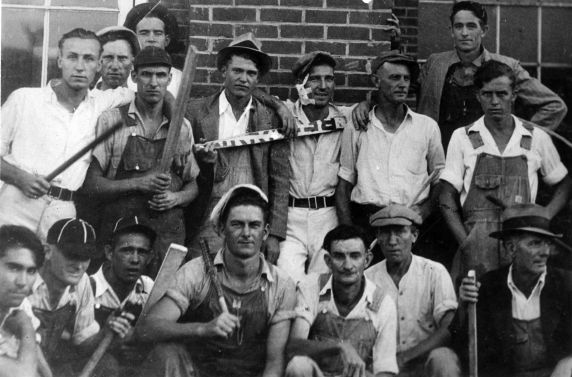
In the picture above, armed workers from the Trion Cotton Mill blocked the exterior of the building during the Georgia textile workers strike.
Caption on the back of the photograph reads: “Pickets carrying sticks, iron bars, and clubs in front of the Trion Cotton Mill, Trion, GA. Here two persons – one an officer – were killed in a clash Sept. 5. Deputy Sheriff W.M. Hix and J.B. Blalock, a strike sympathizer, were shot fatally. After the fight the pickets reformed their lines and the mill closed. The picket with the bandaged neck is Mac Harris, wounded in the fight.”
The strike wasn’t limited just to mills in the South; Northern textile workers walked off the job as well. In neighboring Alabama there were over 22,000 people who participated in the strikes. In all, around 300,000 people walked off their jobs in cotton mills across the nation. The New York Times headline for July 17, 1934 read,
FIRST CLASH AT TRION, GA.; Violence Follows Trail of Mass Picket Drive Elsewhere in South
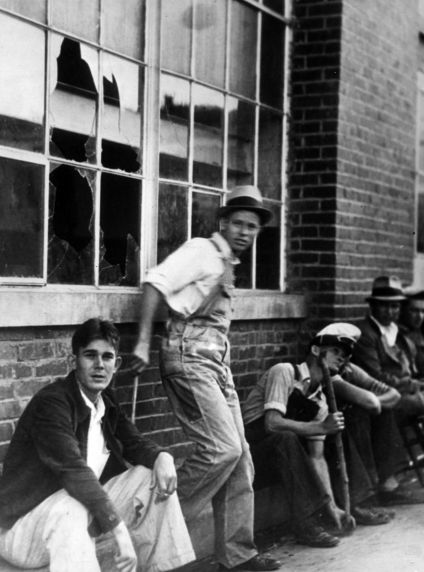
Photo Credit: Wayne State University / Striking workers in Trion, Georgia
Enraged by the strike, owners of the mills successfully encouraged government officials to crack down on striking workers.
In South Carolina, for example, Gov. Ibra Charles Blackwood deputized “mayors, sheriffs, peace officers, and every good citizen” and “dispatched the National Guard with orders to shoot to kill any picketers who tried to enter the mills.” Days later, the Gov. John Ehringhaus did the same, followed by the governors of Maine, Georgia, and Connecticut. In Rhode Island, the governor declared martial law.
In Trion, a guard at the mill and a worker were both killed on July 16th.
The strike would end when President Franklin D. Roosevelt announced his support for the report of a mediation committee he had created at the beginning of the strike. The United Textile Workers Union proclaimed victory, but little was actually achieved at the time.
In fact, most of the mill workers in Trion, and elsewhere that participated in the strike, were simply fired from their jobs.
Comments