










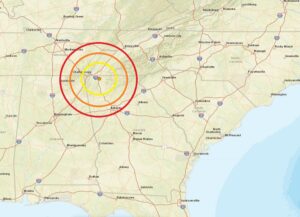
According to USGS, a weak magnitude 2.0 earthquake struck northern Georgia Friday morning north and west of Atlanta at 4:11 am. Located just out of Dalton, the earthquake struck from a depth of 15.9 km. There were no widespread reports of shaking, no injuries, and no damage.
According to USGS, people can begin to notice, hear, or feel earthquakes with a magnitude of 2.0 or greater. At magnitudes of 2.5 and greater, most people feel them and minor damage is possible. At magnitudes of 5.5 and greater, damage could become more widespread or severe. With magnitudes greater than 6.1, there could be a lot of damage in very populated areas. A 7.0 or greater earthquake is considered a major earthquake; a major earthquake can create widespread serious damage. An earthquake of 8.0 or greater is considered a great earthquake; an earthquake of this intensity could totally destroy communities near the epicenter.
According to Georgia’s Emergency Management and Home Security Agency (GEMA), approximately 15 percent of the world’s earthquakes are scattered over areas like Georgia that lack clearly defined active faults. Although earthquakes in Georgia are comparatively rare, scattered earthquakes caused significant damage and are an important consideration for homeowners. Georgia’s northwest counties, South Carolina border counties, and central and west central Georgia counties are most at risk.
GEMA recommends that people in Georgia plan for the risk of damaging earthquakes, especially if they’re in the northern Georgia counties of Bartow, Catoosa, Chattooga, Dade, Fannin, Floyd, Gilmer, Gordon, Murray, Pickens, Rabun, Towns, Union, Walker, and Whitfield, the South Carolina border counties of Burke, Chatham, Columbia, Effingham, Elbert, Lincoln, Richmond, and Screven, and central and west-central counties of Twiggs, Bibb, Jones, Baldwin, Hancock, Greene, Putnam, Butts, Jasper, Newton, Morgan, Walton, Harris, and Muscogee.
GEMA writes, “It’s important to be aware of your earthquake risk and to know how to protect yourself.” They encourage people to take a moment now to learn basic steps they should take before, during, and after an earthquake.
Read more HERE
Comments