










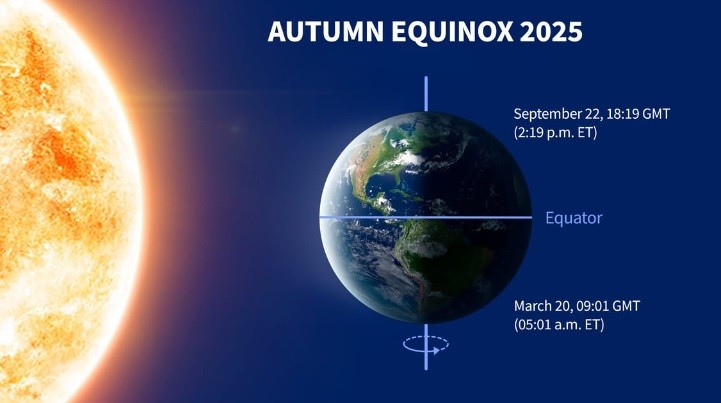
Today, Monday, September 22, 2025, ushers in the official start of astronomical autumn for the Northern Hemisphere, as the autumnal equinox arrives, signaling a celestial turning point and a season of transition.
This precise moment, when the sun crosses the celestial equator, marks the beginning of astronomical autumn. For residents above the equator, it’s a time to anticipate changing leaves, cooler temperatures, and increasingly shorter days, even as the earth temporarily balances its tilt.
What Exactly is the Autumnal Equinox?
The autumnal equinox is a pivotal astronomical event defined by the sun’s position relative to Earth:
- Sun’s Position: At the exact moment of the equinox, the sun is directly above the Earth’s equator. This unique alignment means the sun’s rays are shining equally on both the Northern and Southern Hemispheres.
- Earth’s Tilt: Crucially, during the equinox, the Earth’s axial tilt is in a neutral position—neither leaning toward nor away from the sun. This temporary straightening of the planet’s axis relative to the sun is what creates the characteristic effects of the equinox.
- “Equal Night”: The term “equinox” itself originates from Latin words “aequus” (equal) and “nox” (night). This refers to the approximately 12 hours of daylight and 12 hours of darkness experienced across most of the world on this day. While not perfectly equal everywhere due to atmospheric refraction, it’s the closest the globe gets to a balanced day-night split.
Why Does the Date of the Equinox Change?
While today marks the equinox in 2025, the exact date can vary slightly year to year. This variability boils down to a fascinating interplay between Earth’s orbit and our calendar system:
- Earth’s Orbit: The Earth’s journey around the sun, known as the tropical year, isn’t an exact 365 days. It’s approximately 365.2422 days. This fractional difference means the precise moment of the equinox shifts slightly each year.
- Calendar Alignment: Our Gregorian calendar is primarily made up of 365 days. Without adjustments, this would cause the astronomical events like equinoxes and solstices to gradually drift through our calendar dates.
- Leap Years to the Rescue: To keep the calendar aligned with the Earth’s true tropical year, a leap day (February 29th) is added every four years. This extra day works to pull the dates of the equinoxes and solstices back to their earlier positions, ensuring our seasons remain synchronized with the calendar year.
As the Northern Hemisphere officially enters astronomical autumn today, sky-watchers and nature enthusiasts alike can appreciate the precise cosmic mechanics that govern our seasons, marking the transition from summer’s vibrant growth to fall’s crisp, reflective embrace.
Comments