









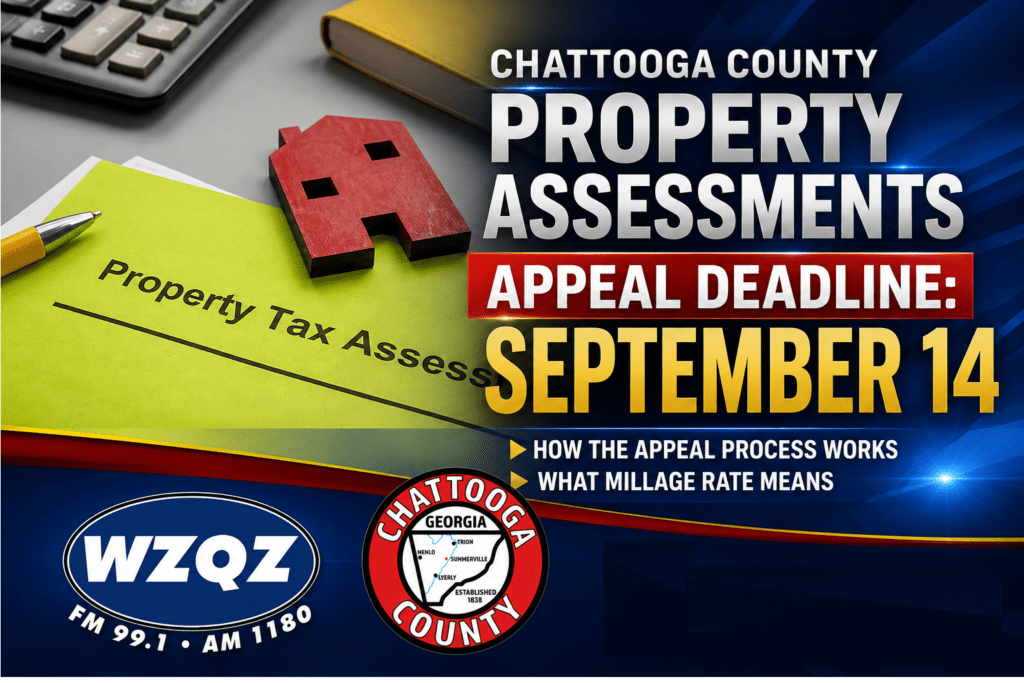
With 2026 property assessment notices arriving in mailboxes across Chattooga County, property owners are being reminded that September 14 is the deadline to appeal their assessment if they believe their property has been incorrectly valued.
For taxpayers seeing an increase this year, it is important to understand both the appeal process and another term that will become increasingly important as tax bills are calculated — the millage rate.
First, an assessment notice is not a property tax bill. The assessment establishes the value used as part of the property tax calculation. The final amount owed will also depend on exemptions and the millage rates levied by the applicable taxing authorities.
September 14 Is The Appeal Deadline
Property owners who disagree with their 2026 assessment have until September 14, 2026, to file an appeal.
Georgia law generally provides property owners 45 days from the mailing date of an annual assessment notice to appeal to the County Board of Tax Assessors.
An appeal can involve the property’s value, taxability, uniformity of assessment or denial of an exemption.
Property owners considering an appeal should not wait until the deadline approaches. Supporting information can include recent sales of comparable properties, photographs showing the property’s condition, an independent appraisal or other documentation that supports the owner’s opinion of the property’s fair market value.
The appeal is filed with the County Board of Tax Assessors, not with the Georgia Department of Revenue.
Georgia provides several avenues for property tax appeals, including the Board of Equalization, arbitration and, in qualifying cases, a hearing officer.
Regardless of which appeal method is selected, the key date for Chattooga County property owners this year is September 14.
What Does “Millage Rate” Mean?
The millage rate is the tax rate applied to a property’s taxable assessed value.
One mill represents $1 in property tax for every $1,000 of assessed value.
Georgia generally assesses property for tax purposes at 40 percent of its fair market value.
For example, consider a home with a fair market value of $200,000.
At 40 percent, the assessed value would generally be:
$200,000 × 40% = $80,000
If the hypothetical tax rate were 25 mills, the calculation before exemptions would be:
$80,000 ÷ 1,000 × 25 = $2,000
The resulting tax would be $2,000 before applicable exemptions or other adjustments.
A Higher Assessment Doesn’t Automatically Mean The Same Percentage Increase In Your Tax Bill
This is one of the most important distinctions for property owners.
If a home’s assessed value increases by 20 percent, that does not automatically mean the final property tax bill will increase by 20 percent.
The ultimate bill depends on the property’s taxable assessed value after exemptions and the millage rates ultimately levied by the taxing jurisdictions.
That is why taxpayers should distinguish between the property value appearing on an assessment notice and the tax rate that will later be applied to that value.
Who Determines Property Values And Who Sets The Tax Rate?
The two functions are separate.
The Board of Tax Assessors is responsible for property valuation and assessment. The Tax Assessor’s Office does not simply decide how much an individual property owner will ultimately pay in taxes.
Millage rates are established by the governments and taxing authorities that levy property taxes.
In Chattooga County’s sole-commissioner form of government, the county government’s millage decision is made by the Sole Commissioner. The Chattooga County Board of Education separately establishes the school system’s millage rate.
Municipal taxes, where applicable, are also separate.
What Is The Rollback Rate?
Property owners may also hear discussion of the rollback millage rate as local governments move through the annual budget and property tax process.
When reassessments increase the value of existing property on the tax digest, a rollback rate essentially shows the millage rate that would offset that inflationary increase in the digest.
In simple terms, if the same group of properties becomes more valuable on paper, a lower millage rate could potentially generate the same amount of tax revenue from those properties.
If a taxing authority does not roll its millage rate back sufficiently to offset reassessment-related growth, Georgia law can require additional public notices and hearings.
This is why an increase in the countywide tax digest does not, by itself, tell taxpayers exactly how much their individual tax bills will change.
Review Your Assessment Now
Chattooga County property owners should carefully review their 2026 assessment notices, paying particular attention to the fair market value, assessed value, exemptions and property information shown on the notice.
If something appears incorrect or an owner believes the valuation does not reflect the property’s fair market value, the assessment appeal process provides the opportunity to challenge it.
But that opportunity has a deadline.
For Chattooga County’s 2026 property assessments, appeals must be filed by September 14.
Property owners should follow the filing instructions included with their assessment notice and contact the appropriate local tax office if they have questions about the process.
For taxpayers trying to make sense of property taxes this year, remember these three points:
40 percent — the general assessment ratio used for Georgia property taxes.
One mill — $1 of tax for every $1,000 of taxable assessed value.
September 14 — the deadline to appeal a 2026 Chattooga County property assessment.
Comments