







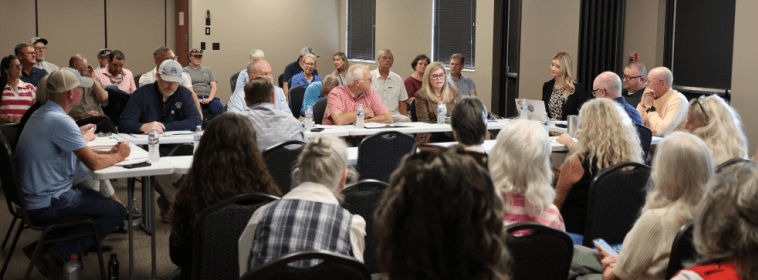
Walker County officials are beginning work on new regulations for data centers as communities across Georgia see increasing interest from companies developing large-scale digital infrastructure projects.
The Walker County Data Center Development Standards Study Committee held its first meeting this past week, drawing more than 40 residents. The committee is tasked with examining how the county should regulate future data center projects in unincorporated areas while protecting local resources and residents’ quality of life.
Walker County Planning and Zoning Director Jon Pursley told the committee that the county currently has no ordinances specifically addressing data center development. County staff began researching the issue in March and have reviewed regulations adopted in places including Whitfield and Bartow counties. Pursley said an outright ban is not considered legally viable, meaning the focus is on establishing standards for how such developments would operate.
One of the biggest concerns discussed during the meeting was the enormous amount of electricity some data centers can require. Committee members pointed to a neighboring 170-acre development in Dalton that requires about 140 megawatts of power. Members also discussed recent changes by the Tennessee Valley Authority aimed at ensuring data centers and other very large electricity users pay the full cost of the infrastructure and power required to serve them.
Water use was another major topic. Officials said Walker County could require data centers to use closed-loop cooling systems, which recirculate water rather than continually drawing new supplies. The committee also discussed possible limits on water consumption, filtration requirements and higher utility rates for data center operators to help pay for infrastructure improvements.
Committee members also raised concerns about noise, lighting and the impact on nearby homes and wildlife. One proposal discussed would increase the current 50-foot commercial-to-residential setback to as much as 200 feet, including 20 feet of dedicated greenspace. Continuous sound monitoring was also suggested.
Tax incentives generated some of the strongest discussion.
District 4 appointee Travis Middleton opposed lengthy tax abatements, arguing that agreements lasting as long as 30 years could negatively affect local school funding. District 1 appointee Barney Danks also voiced opposition to tax abatements. Middleton said he also does not believe the county should pay for utility extensions such as water lines to serve new data center developments.
Other ideas discussed included requiring data center operators to enter into Community Benefit Agreements, establishing requirements for eventual decommissioning of facilities and tightening zoning language so a property could not later be converted to another intensive use without county oversight.
Officials pointed to Floyd County’s recently adopted data center ordinance as one possible model, particularly its provisions dealing with decommissioning and development standards.
The Walker County committee will now examine ordinances adopted by neighboring communities and gather additional information about different types and sizes of data centers.
The committee is scheduled to meet again September 10 and plans to meet every other Thursday at 4 PM on the Walker County Civic Center campus.
Comments