










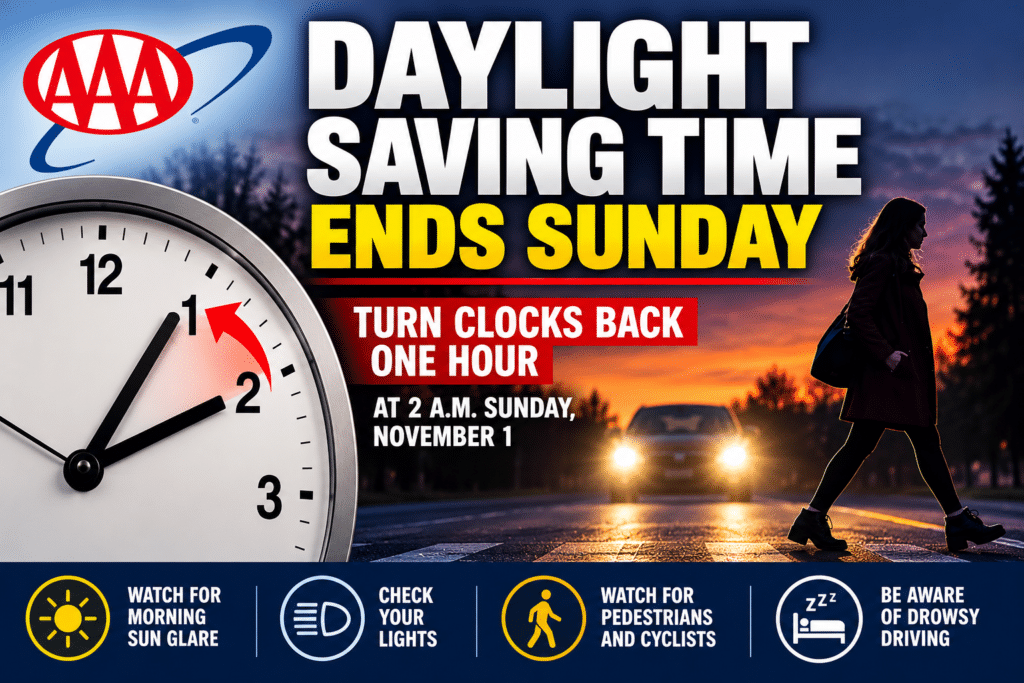
Daylight saving time comes to an end this weekend, and AAA is reminding motorists to prepare for changing driving conditions as the clocks move back one hour.
At 2 a.m. Sunday, November 1, clocks will be turned back to 1 a.m., marking the return to standard time. The change means an extra hour of sleep for many people, but it also brings earlier sunsets and darker conditions during the evening commute.
AAA says the adjustment can create additional hazards for drivers, pedestrians and bicyclists, particularly during the first several days following the time change.
“Drivers can expect a noticeable change in their commute almost overnight,” said Montrae Waiters, spokeswoman for AAA – The Auto Club Group. “Morning sun glare can make it difficult to see the road ahead, while earlier darkness makes pedestrians and cyclists harder to spot in the evening.”
For motorists in Chattooga County and throughout Northwest Georgia, the earlier darkness is especially important on rural highways and secondary roads, where lighting may be limited and drivers frequently encounter curves, hills and narrow shoulders.
AAA points to research from its Foundation for Traffic Safety showing that the increase in pedestrian fatalities since a historic low in 2009 has occurred almost entirely during nighttime hours. Research from the Insurance Institute for Highway Safety also indicates that pedestrian deaths increase when standard time returns.
Drowsy driving is another concern associated with changes in sleep schedules. According to the National Highway Traffic Safety Administration, 644 people were killed in crashes involving drowsy drivers in 2024.
Warning signs of fatigue include difficulty keeping your eyes open, drifting out of your lane or being unable to remember the last several miles driven. AAA recommends pulling over in a safe location to rest rather than continuing to drive while tired.
AAA offers several recommendations for motorists adjusting to the time change:
- Watch for morning sun glare. Keep sunglasses available, use sun visors and maintain a clean windshield.
- Increase following distance. Allow extra room between vehicles, particularly when visibility is reduced.
- Check vehicle lighting. Make sure headlights, taillights, brake lights and turn signals are working properly.
- Slow down after dark. Drive at a speed that allows you to stop within the distance illuminated by your headlights.
- Watch for pedestrians and bicyclists. Pay particular attention at intersections, crosswalks and along roads with limited lighting.
The time change also serves as a reminder for residents to check smoke alarm batteries and review other household safety precautions.
Daylight saving time officially ends at 2 a.m. Sunday, November 1. Clocks should be set back one hour before going to bed Saturday night.
Source: AAA – The Auto Club Group; National Highway Traffic Safety Administration; AAA Foundation for Traffic Safety; Insurance Institute for Highway Safety.
Comments