










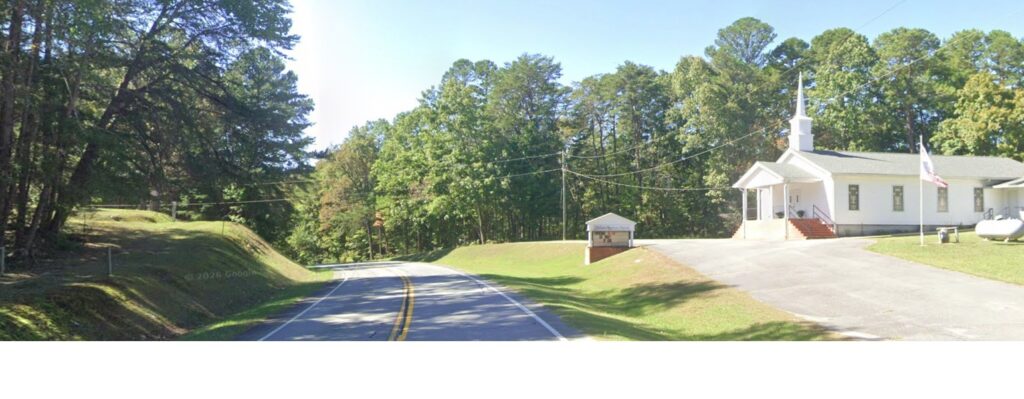
Nestled in Broomtown Valley along the eastern slopes of Lookout Mountain, the Chelsea community has a history that stretches back to the early settlement of western Chattooga County. Although never incorporated as a town, Chelsea was once home to its own school, post office, church and railroad passenger stop. The community also holds a special place in the history of Southern folk art through its association with the Reverend Howard Finster, who served as pastor of Chelsea Baptist Church long before becoming an internationally recognized artist.
While Chelsea has changed considerably over the generations, its history can still be traced through the families who settled there, the railroad that connected it to neighboring communities, and the church that remains one of its most recognizable landmarks.
Early Settlement And The Families Of Chelsea
According to the Chattooga County Historical Society, the Harper, Atkinson and Strickland families were among the earliest settlers in the Chelsea area. Like other communities throughout Broomtown Valley, Chelsea developed around farming, family connections and religious institutions. The community took shape in the valley between Lookout Mountain and Shinbone Ridge, where creeks, springs and farmland provided the setting for generations of rural life.
The Chelsea community was never a municipality with a formal town government, but it developed many of the institutions that defined rural settlements during the nineteenth century. Residents maintained connections through their church, school and local businesses, while the area’s farms supported families who made their homes along the valley.
The name Chelsea became established enough to appear on maps and in postal records during the late nineteenth century, and several natural landmarks in the area continue to carry the community’s name.
Chelsea’s Post Office And Early School
By the late nineteenth century, Chelsea had become established enough to warrant its own United States post office. The Chelsea Post Office opened on December 27, 1890, and remained in operation until December 31, 1928, serving the community for approximately 38 years.
During those years, the post office was an important connection between Chelsea residents and the outside world. It provided a place to send and receive letters, newspapers and business correspondence at a time when rural communication depended heavily on the postal system. The closure of small community post offices was part of a broader change in rural America as mail delivery systems expanded and transportation improved.
Chelsea also maintained a neighborhood school during the era when small rural schools were scattered throughout Chattooga County. Those schools often served children living within walking distance and played an important role in community life. Chelsea School eventually became part of an earlier chapter in local education as schools throughout the county were consolidated into larger facilities.
The TAG Railroad And Chelsea’s Scooter Stop
Transportation played an important role in Chelsea’s development. The Chattanooga Southern Railway began operating through western Chattooga County during the late nineteenth century, connecting the region with Chattanooga, Tennessee, and Gadsden, Alabama. The railroad was reorganized in 1911 as the Tennessee, Alabama and Georgia Railway, better known locally as the TAG Railroad. Its route through Broomtown Valley brought passenger and freight service to several small communities, including Chelsea.
Although Chelsea did not have a railroad depot, it was an established passenger stop along the TAG line. One of the railroad’s most fondly remembered services was a small motorcar passenger train known as the “Scooter,” which provided transportation for residents traveling between communities along the railroad. For people living in Chelsea and surrounding rural areas, the Scooter offered an alternative to traveling by wagon or automobile, particularly during the years when roads were less developed and car ownership was not widespread.
A surviving TAG Railroad timetable from May 1929 confirms Chelsea’s place on the passenger route. The schedule lists Chelsea 42.8 rail miles from Chattanooga, between Harrisburg and Menlo. Southbound service was scheduled to arrive at Chelsea at 9:36 in the morning, while northbound service was listed at 2:54 in the afternoon. Menlo was only 3.4 rail miles south of Chelsea, illustrating how closely the railroad connected the small communities of Broomtown Valley.
The TAG Railroad was an important transportation corridor for western Chattooga County for decades. While passenger service eventually disappeared, memories of the Scooter and the railroad’s role in the valley remain part of the area’s history.
Howard Finster And Chelsea Baptist Church
Chelsea’s most widely recognized historical connection may be to the Reverend Howard Finster, whose years at Chelsea Baptist Church preceded his rise to international fame as one of America’s best-known self-taught artists. Finster served as pastor of the church for approximately 15 years, from 1950 until 1965, during a period when he was known primarily as a Baptist minister, revival preacher and carpenter. His ministry took him throughout the surrounding communities, where he preached, conducted baptisms and participated in the religious life of rural Chattooga County.
Finster’s association with Chelsea Baptist Church extended beyond the pulpit. He used his carpentry skills to help with construction work at the church and created religious artwork that remains an important part of its history. Among those works is a mural he painted at the church’s baptistry, which remains in place today. The mural provides a tangible connection to Finster’s years in Chelsea and to the religious themes that would later become central to his artistic career.
The baptistry mural is separate from another Finster painting associated with Chelsea Baptist Church that attracted attention in 2020. As WZQZ News reported in November of that year, a painting titled Chelsea Baptist Church was offered for auction to raise money for improvements to the congregation’s facilities. Commissioned by a Sunday School class, the artwork depicted the baptism of Jesus in the Jordan River, along with a smaller scene showing worshipers entering the church. The congregation hoped the painting could continue spreading Finster’s religious message while providing financial assistance for needed improvements.
The Chattooga County Historical Society has also preserved a photograph showing Finster conducting a baptism in Chelsea Creek during the 1940s. The photograph offers a glimpse of an earlier era when outdoor baptisms were common in rural churches and local creeks served as gathering places for important religious occasions.
Finster would eventually gain worldwide recognition for his artwork and Paradise Garden, his extraordinary folk-art environment in the Pennville area. His work appeared on the cover of the Talking Heads album Little Creatures, and his paintings became sought after by museums and collectors. Yet his years as a minister in Chelsea remain an important part of the story of the man who would become one of Georgia’s most celebrated folk artists.
Chelsea’s Geography And Natural Landmarks
The natural landscape surrounding Chelsea is another important part of the community’s identity. Chelsea Creek and Chelsea Gulf are among the geographical features that preserve the community’s name, while nearby Blowing Spring is associated with the limestone formations found along the eastern slopes of Lookout Mountain.
The area is situated in Broomtown Valley, between Lookout Mountain to the west and Shinbone Ridge to the east. The valley’s terrain helped shape early settlement patterns, with farms, roads and communities developing along the relatively level land between the ridges. Chelsea’s location also placed it along a natural transportation corridor later used by the TAG Railroad.
Geological studies conducted during the twentieth century documented limestone deposits in the area, and exploratory drilling north of Chelsea during the 1960s examined the possibility of commercially valuable mineral resources. Those investigations provide another glimpse into the changing uses of the land surrounding the community.
Chelsea’s Place In Chattooga County History
Over the generations, Chelsea experienced many of the changes that affected rural communities throughout Chattooga County. Its post office closed, the neighborhood school became part of an earlier chapter in local education, and the TAG Railroad’s passenger service faded into history. Improved roads and automobiles gradually changed how residents traveled, worked and conducted business, reducing the importance of institutions that had once helped define small rural settlements.
Despite those changes, Chelsea has retained its identity as a community. Chelsea Baptist Church and its cemetery remain important local landmarks, while the names of early families, the surviving artwork of Howard Finster and memories of the TAG Railroad’s Scooter continue to connect the area with its past.
The history of Chelsea is a reminder that Chattooga County’s story is not limited to its incorporated towns or major industrial centers. Communities such as Chelsea helped shape the county through generations of farming, education, religious life and transportation, leaving a heritage that continues to be part of western Chattooga County today.
Sources:
- Chattooga County Historical Society — Broomtown Valley Communities and Historical Photo Archives.
- Kenneth K. Krakow — Georgia Place-Names: Their History and Origins, Chelsea entry, documenting the post office dates.
- Tennessee, Alabama and Georgia Railway — Railroad History and May 1929 Passenger Timetable.
- Smithsonian Institution, Archives of American Art — 1984 Oral History Interview With Howard Finster.
- High Museum of Art — Howard Finster’s Ministry And Artwork.
- WZQZ News, November 14, 2020 — Finster Painting To Be Auctioned – Proceeds Will Help Chattooga County Church.
- Paradise Garden / Howard Finster — Artist Biography.
Comments