







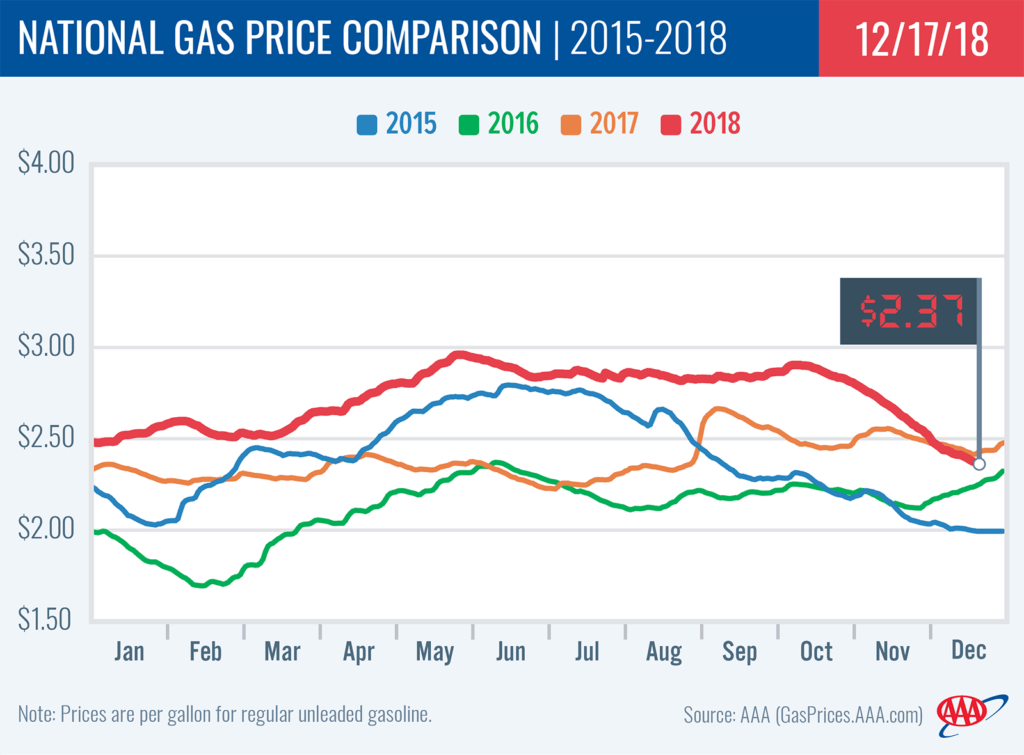
At $2.37, the national gas price average continues to drive toward the cheapest pump prices seen during the month of December since 2016, which is welcome news for the millions of Americans expected to begin holiday travel later this week.
“AAA expects 102 million Americans to drive to their holiday destination this year, which is a four percent increase year-over-year,” said Jeanette Casselano, AAA spokesperson. “No doubt cheaper gas prices are fueling their decision to hit the road.”
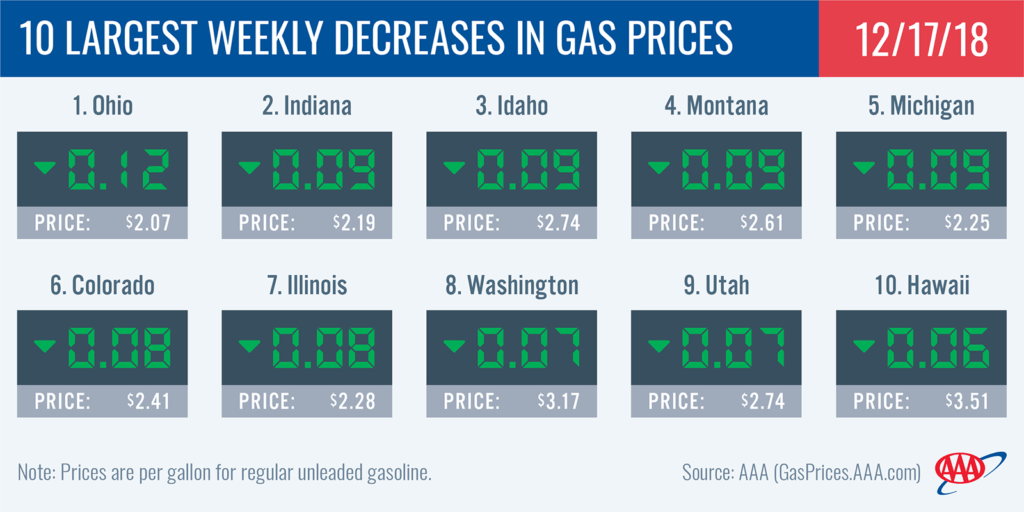
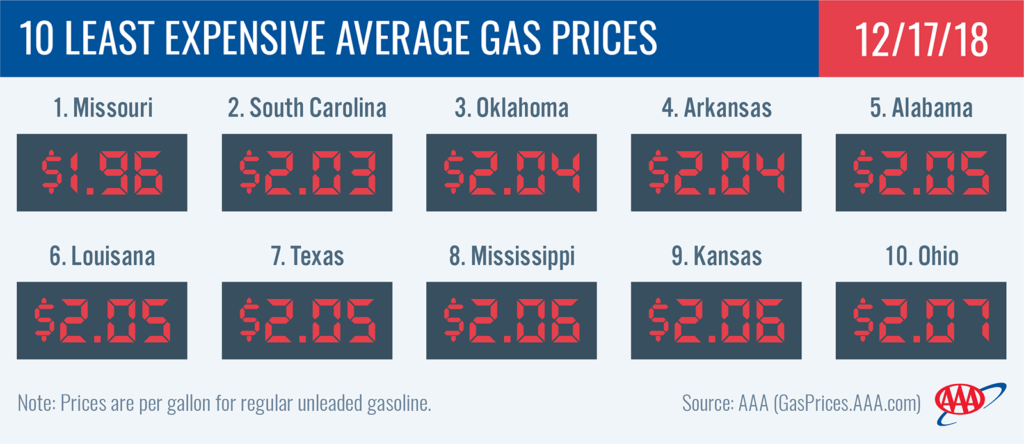
On the week, states are seeing gas price averages that are as much as 12-cents cheaper. Florida (+1 cent) is the only state to see gas prices increase, while Missouri’s gas price average dropped to $1.96.
The national average is a nickel less than last week, 26-cents less than last month and six-cents less than a year ago. With gasoline production on the high side – 10 million b/d – amid low demand, motorists can expect gas prices to continue declining through year-end.
Quick Stats
- The nation’s top 10least expensive markets are: Missouri ($1.96), South Carolina ($2.03), Oklahoma ($2.04), Arkansas ($2.04), Alabama ($2.05), Louisiana ($2.05), Texas ($2.05), Mississippi ($2.06), Kansas ($2.06) and Ohio ($2.07).
- The nation’s top 10 largest weekly decreases are: Ohio (-12 cents), Indiana (-9 cents), Idaho (-9 cents), Montana (-9 cents), Michigan (-9 cents), Colorado (-8 cents), Illinois (-8 cents), Washington (-7 cents), Utah (-7 cents) and Hawaii (-6 cents).
South and Southeast
Many South and Southeast states have gas price averages that are pennies away from falling below $2/gal: South Carolina ($2.03), Oklahoma ($2.04), Arkansas ($2.04), Alabama ($2.05), Louisiana ($2.05), Texas ($2.05) and Mississippi ($2.06). These states also rank among the top 10 cheapest averages in the country this week. Pump prices are at least a dime more expensive in Georgia ($2.18), Florida ($2.29) and New Mexico ($2.30). On the week, Florida (+1 cent) was the only state in the country and region to see prices increase.
Gasoline stocks built by 3 million bbl on the week, wiping out the previous week’s draw. The build brings the region’s total stock levels to 83.8 million bbl, which is a 5.4 million bbl year-over-year surplus. Since demand is low this time of year, it is not uncommon to see stocks build during December.
Oil market dynamics
At the close of Friday’s formal trading session on the NYMEX, WTI decreased $1.38 to settle at $51.20. Oil prices mostly fell last week as market observers continue to worry that the global crude market is oversupplied. Although the Organization of the Petroleum Exporting Countries (OPEC) and other oil producers, including Russia, agreed last week to reduce output by 1.2 million barrels per day at the beginning of 2019, crude prices will likely remain low until the production reduction agreement is in place.
In related news, total domestic crude inventories are continuing to slide. Crude inventories around the country fell by 1.2 million bbl, according to new data released by EIA. Stocks now total 442 million bbl, which is approximately 1 million bbl lower than where they were at this time last year. With domestic inventories now falling and OPEC’s production reduction agreement set to take effect in early 2019, crude prices could increase early next year. If they do, motorists will likely see pump prices increase.
Motorists can find current gas prices along their route with the free AAA Mobile app for iPhone, iPad and Android. The app can also be used to map a route, find discounts, book a hotel and access AAA roadside assistance. Learn more at AAA.com/mobile.
Comments