










Small Earthquake Recorded In Cloudland Area Wednesday Morning

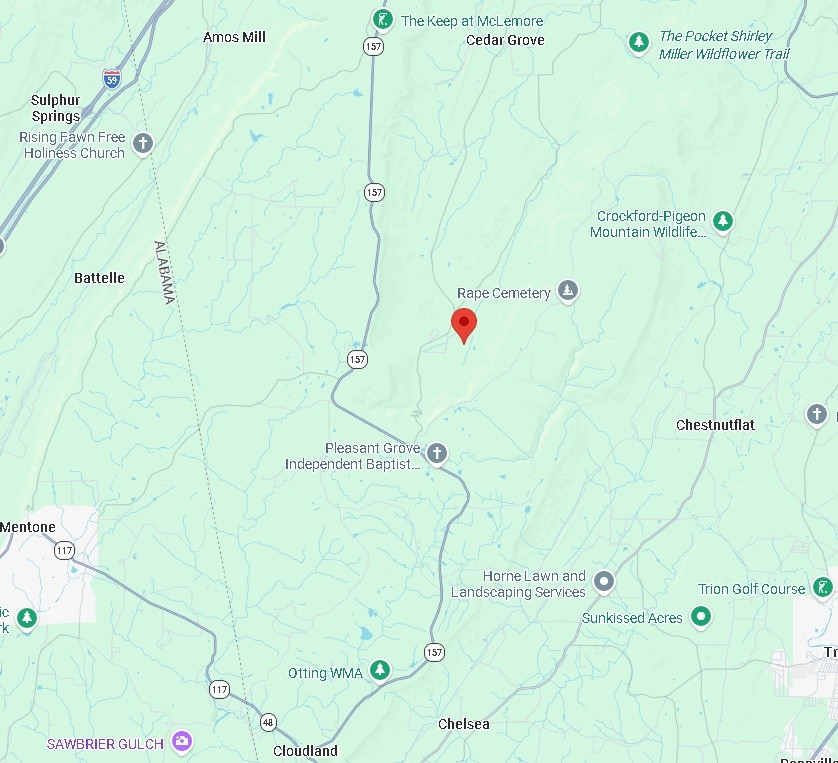
A small earthquake was recorded early Wednesday morning just north of the Chattooga-Walker County line in the Cloudland area of Northwest Georgia.

The Center for Earthquake Research and Information at the University of Memphis recorded the magnitude 1.97 earthquake at 4:25 AM Wednesday, September 30. The earthquake had a reported depth of about 3.2 miles.

Coordinates provided for the earthquake — 34.631 degrees north and 85.440 degrees west — place the epicenter just inside Walker County, north of the Chattooga County line and closer to the Pigeon Mountain area.

The location can still be described locally as the Cloudland area, which extends beyond the community itself and includes portions of the Lookout Mountain area in Chattooga, Walker and Dade counties.

The earthquake was reported by CERI as approximately 10.4 miles north of Menlo.

At just under magnitude 2.0, Wednesday’s earthquake was relatively small and would not normally be expected to cause damage. People close to the epicenter, however, may have noticed a brief vibration or rumbling.

It is also the second small earthquake recorded near Chattooga County in a little more than a month. A magnitude 2.08 earthquake was recorded about one-half mile west of Trion on August 24.

Residents who felt Wednesday morning’s earthquake can report what they experienced through the U.S. Geological Survey’s “Did You Feel It?” system.

2.1 Magnitude Earthquake Recorded Near Trion Early Monday Morning

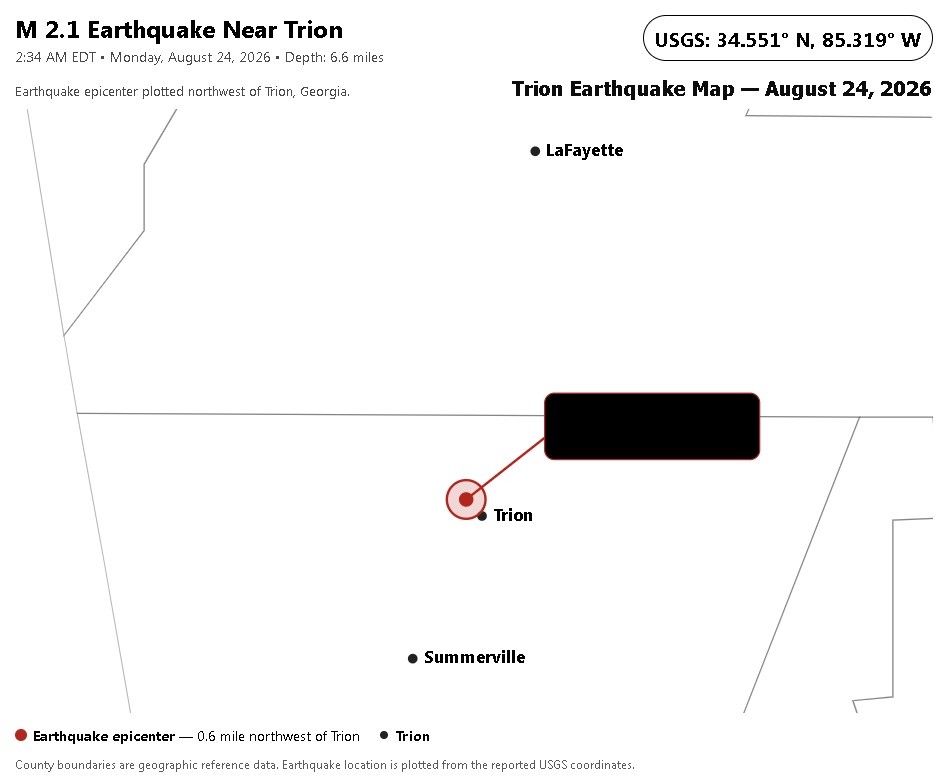
A small earthquake was recorded just outside Trion early Monday morning, according to the U.S. Geological Survey.

The USGS says the magnitude 2.1 earthquake occurred at 2:34 AM Monday, August 24, with the epicenter located approximately 1 kilometer, or six-tenths of a mile, northwest of Trion.

The earthquake was recorded at a depth of approximately 10.6 kilometers, or 6.6 miles below the surface. The USGS lists the center of the earthquake at 34.551 degrees north latitude and 85.319 degrees west longitude. The event has been reviewed by the USGS rather than remaining an automatic preliminary detection.

As of Monday afternoon, the USGS had no reports from residents saying they felt the earthquake, and there were no reports of damage associated with the event.

Monday morning’s earthquake comes just two days after another small earthquake was recorded in Northwest Georgia.

On Saturday, August 22, the USGS recorded a magnitude 2.4 earthquake about 10 kilometers, or roughly six miles, west-northwest of Resaca. That earthquake occurred at 4:54 AM EDT at a depth of approximately 9.4 kilometers, or 5.8 miles.

USGS data indicates the Trion earthquake is the only earthquake of magnitude 1.5 or greater recorded in Georgia during the past 24 hours, while the Trion and Resaca events are the two such earthquakes recorded in the state during the past seven days.

Residents who believe they felt Monday morning’s earthquake can submit a “Did You Feel It?” report to the U.S. Geological Survey.

Small Earthquake Reported About 18 Miles From Summerville

A small earthquake was recorded in Northwest Georgia early Saturday morning, with the epicenter located west of Resaca and roughly 18 miles east of Summerville.

According to information from the University of Memphis Center for Earthquake Research and Information, the magnitude 2.4 earthquake occurred at approximately 4:54 AM EDT on Saturday, August 22.

The earthquake was centered about 6.3 miles west of Resaca, on the west side of Interstate 75. Resaca itself is approximately 24 miles east of Summerville as the crow flies, placing the reported epicenter about 18 miles from Summerville.

A magnitude 2.4 earthquake is considered minor. Earthquakes of that size can sometimes be felt by people close to the epicenter, particularly indoors or during the quiet early-morning hours, but they generally are not strong enough to cause damage.

Small earthquakes are not unheard of in North Georgia. The region is capable of producing minor seismic activity, although most earthquakes recorded in Northwest Georgia are small and may only be detected by sensitive seismic instruments.

The University of Memphis Center for Earthquake Research and Information, commonly known as CERI, operates seismic monitoring equipment throughout portions of the central and eastern United States and tracks earthquake activity across the region.

There were no immediate reports of damage associated with Saturday morning’s earthquake.

Source: University of Memphis Center for Earthquake Research and Information.