






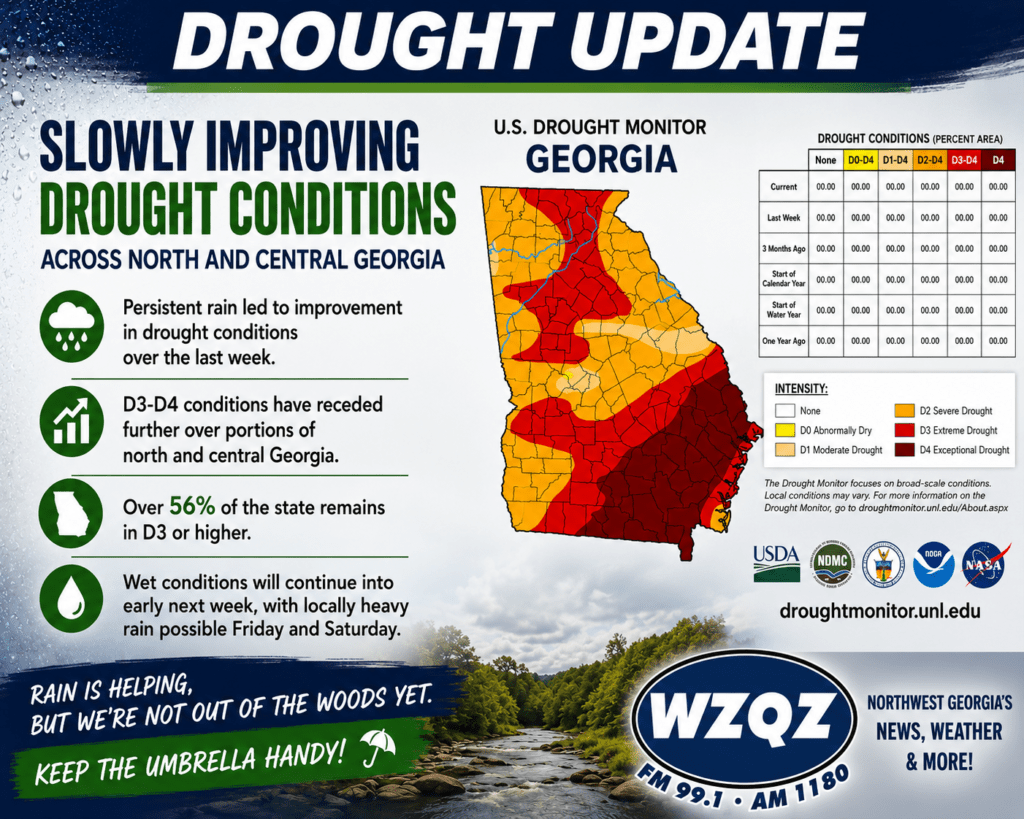
Weeks of steady rainfall are beginning to make a noticeable difference across Northwest Georgia, with drought conditions continuing to improve throughout the region.
According to the latest U.S. Drought Monitor released Thursday, drought conditions have eased across portions of north and central Georgia following a wetter-than-normal pattern that has delivered repeated rounds of rain over the past several weeks.
In Chattooga County and much of Northwest Georgia, the most extreme drought classifications have continued to shrink as soils, streams, and vegetation benefit from the recent rainfall. While the improvements are encouraging, meteorologists say the region is not out of the woods yet.
Much of Georgia remains in severe to exceptional drought categories, and long-term rainfall deficits continue to be a concern. Even though the ground has become noticeably wetter at the surface, moisture levels deeper below ground remain below normal after months of dry conditions.
The latest drought data shows more than half of Georgia remains in D3 (Extreme Drought) or D4 (Exceptional Drought) status. However, areas of the state that received frequent rainfall during May have seen significant improvement compared to conditions earlier this spring.
Additional rainfall is expected across Chattooga County and Northwest Georgia through early next week as a stalled weather pattern continues to produce scattered showers and thunderstorms. Forecasters say some locations could receive locally heavy rainfall, which would provide further drought relief but could also create isolated flooding concerns.
The improving conditions are welcome news for farmers, homeowners, and local water systems that have endured months of unusually dry weather. Lawns and pastures have begun to recover in many areas, and stream levels have improved following the recent rounds of rain.
Meteorologists caution that it will likely take several more weeks of near-normal or above-normal rainfall to fully erase the long-term deficits that developed during the prolonged dry spell. Even so, the trend is moving in the right direction as Northwest Georgia heads into the summer months.
Comments