










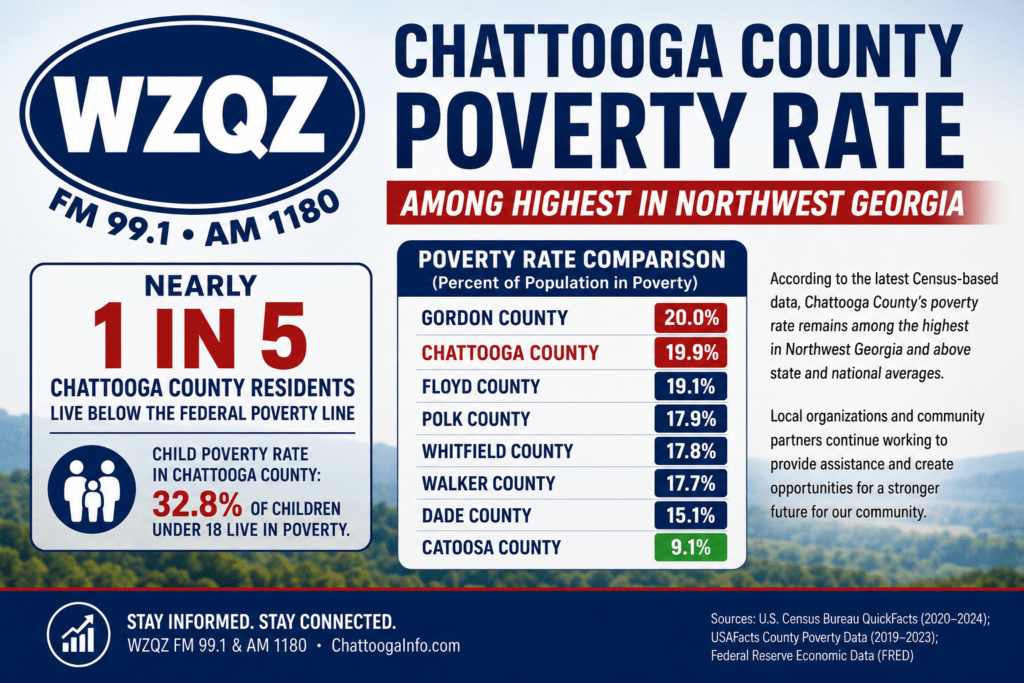
Nearly one out of every five residents in Chattooga County lives below the federal poverty line, giving the county one of the highest poverty rates in Northwest Georgia, according to data from the U.S. Census Bureau and regional economic reports.
The U.S. Census Bureau’s latest QuickFacts data estimates that 18.3% of Chattooga County residents were living in poverty between 2020 and 2024. The county’s median household income was reported at $50,285 during the same period.
Other datasets paint a similar picture. Census-based estimates compiled by Datahood show Chattooga County’s poverty rate at 20.1% for the 2019-2023 period, with an alarming 32.8% of children under age 18 living below the poverty line.
When compared to neighboring counties, Chattooga County ranks near the top of the region for poverty. According to an analysis of Northwest Georgia poverty data, Gordon County reported a poverty rate of 20.0%, followed by Chattooga County at 19.9% and Floyd County at 19.1%. Walker County’s poverty rate was reported at 17.7%, Whitfield County at 17.8%, Dade County at 15.1%, and Catoosa County at just 9.1%.
Those figures reveal a significant economic divide across Northwest Georgia. While roughly one in five Chattooga County residents lives in poverty, Catoosa County’s poverty rate is approximately half that level.
Federal Reserve economic data also shows that Chattooga County’s poverty rate has remained stubbornly high for years, consistently exceeding state and national averages.
Economic experts often point to factors such as educational attainment, workforce opportunities, wages, healthcare access, and housing costs when examining poverty trends. Census data shows that only 12% of Chattooga County adults age 25 and older hold a bachelor’s degree or higher, while nearly 16% of residents under age 65 lack health insurance coverage.
Despite the challenges reflected in the data, local churches, charitable organizations, schools, and community groups continue to provide assistance to families facing financial hardship. Food assistance programs, utility assistance efforts, and workforce development initiatives remain important resources for many county residents.
The latest numbers underscore the economic realities facing many families in Chattooga County and highlight the ongoing need for job growth, workforce training, and economic development efforts throughout the region.
Sources:
- USAFacts, Poverty Rate in Chattooga County, Georgia
https://usafacts.org/answers/what-is-the-us-poverty-rate/county/chattooga-county-ga/ - Federal Reserve Economic Data (FRED), Poverty Rate in Chattooga County, Georgia
https://fred.stlouisfed.org/series/PPAAGA13055A156NCEN - U.S. Census Bureau, American Community Survey (ACS) 5-Year Estimates
https://www.census.gov/programs-surveys/acs
Comments