






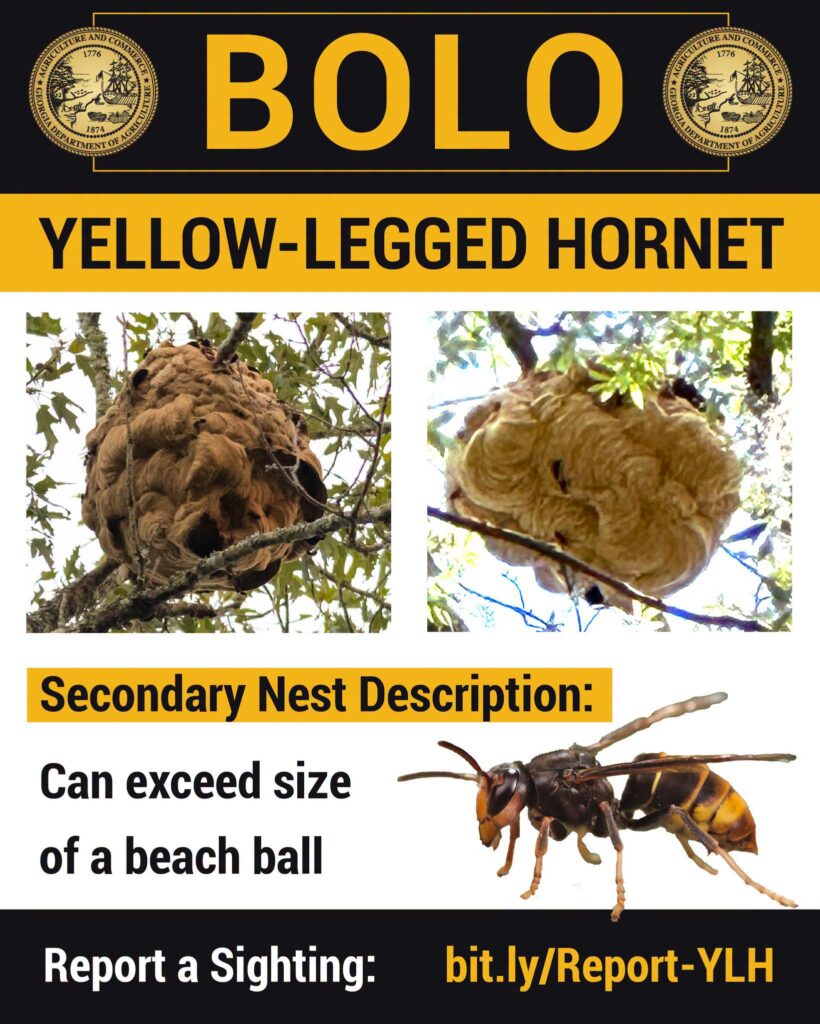
Georgia agriculture officials are continuing an aggressive effort to track and eradicate the invasive yellow-legged hornet, with more than 1,000 of the insects found during August alone.
According to the Georgia Department of Agriculture, crews found 1,090 yellow-legged hornets and 60 nests during August. State personnel also deployed 48 new traps and checked 7,944 existing traps as part of the ongoing eradication program.
The numbers highlight the continuing challenge Georgia faces three years after the insect was first discovered in the state. In August 2023, agriculture officials confirmed a yellow-legged hornet near Savannah — the first confirmed live specimen of the species found in the open United States. The Department of Agriculture, USDA and the University of Georgia have since worked together to trap, track and eradicate the invasive insect.
Despite the increased activity, there have been no confirmed detections in Northwest Georgia. The Georgia Department of Agriculture currently says confirmed yellow-legged hornets in the state have been found in the Savannah area, specifically Chatham, Bryan, Effingham and Liberty counties.
However, officials are asking residents across Georgia to remain alert because preventing the hornet from spreading is considered important to the state’s agriculture industry.
The yellow-legged hornet is especially concerning because it preys on honeybees and other pollinators. Bees are important to the production of a number of Georgia crops, including apples, blueberries, cucumbers and watermelons. The Department of Agriculture says insect pollination contributes more than $34 billion in economic value to agricultural crops nationwide.
Agriculture officials say hot weather has kept hornet activity high and are particularly asking beekeepers to watch for a behavior known as “hawking.” That’s when yellow-legged hornets hover or wait near a beehive and attack bees as they enter or leave the colony.
Residents should also watch for nests. During late summer, yellow-legged hornets can build large secondary nests, often high in trees. Those nests can become larger than a basketball, and the Department of Agriculture says a mature nest can house thousands of hornets.
Officials advise residents not to attempt to remove a suspected yellow-legged hornet nest themselves. Proper eradication is important because the queen must be eliminated, and state agriculture officials may need to place additional traps in the surrounding area to determine whether other colonies are present.
Anyone in Chattooga County or elsewhere in Georgia who believes they have spotted a yellow-legged hornet or nest is encouraged to take a photograph if it can be done safely and report the sighting to the Georgia Department of Agriculture through its online reporting system or by emailing yellow.legged.hornet@agr.georgia.gov.
The Department of Agriculture stresses that several insects commonly found in Georgia can resemble the invasive hornet, so photographs can help officials determine whether a reported insect is actually a yellow-legged hornet.
Comments