









Northwest Georgia Master Cattlemen’s Program Coming To Chattooga County

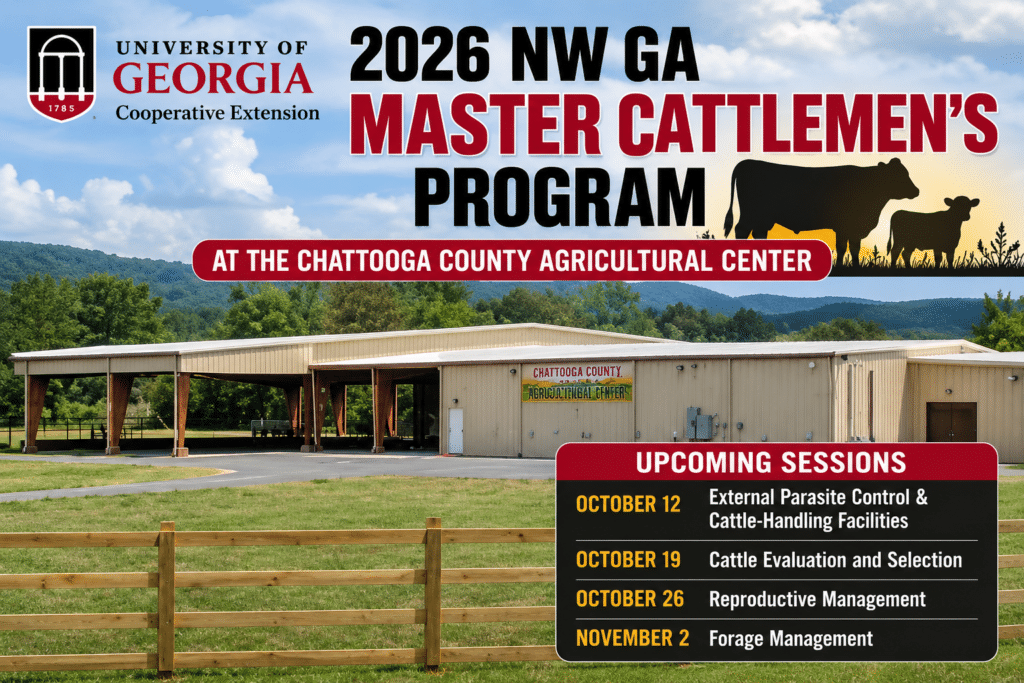
Cattle producers from across northwest Georgia will have an opportunity to expand their knowledge of herd management, nutrition, marketing and other areas of the cattle industry when the 2026 Northwest Georgia Master Cattlemen’s Program comes to Chattooga County this fall.

Read more

Georgia Meat Processors Can Now Sell Products Nationwide Under New USDA Agreement

Small meat processors across Georgia will soon have access to customers across the country following a new agreement between the U.S. Department of Agriculture and the Georgia Department of Agriculture.

Read more

Chattooga County Extension To Host 2026 Northwest Georgia Master Cattlemen’s Program

The Chattooga County Extension Office is now accepting registrations for the 2026 Northwest Georgia Master Cattlemen’s Program, an educational series designed for cattle producers looking to expand their knowledge and improve herd management.

The program will be held Monday evenings at 6:00 p.m. at the Chattooga County Agricultural Center, located at 40 Middle School Road in Summerville.

The registration fee is $100, which includes all in-person sessions, educational materials, a UGA Beef hat, and meals. The registration deadline is September 8.

The Master Cattlemen’s Program is offered through UGA Extension and covers a variety of topics related to beef cattle production and management.

Those interested can register online through the UGA Beef Team website or contact the Chattooga County Extension Office at 706-857-0744 for additional information or assistance with registration.

Chattooga County Extension Encourages Producers To Have Hay Tested

Chattooga County Extension is encouraging livestock producers to have their hay and other stored forage tested while this year’s hay crop is being harvested.

Forage testing provides information about the nutritional value and overall quality of hay, helping producers make better decisions when developing feeding programs for times when fresh grass is unavailable. Hay quality can significantly affect livestock health, growth, performance and the amount of supplemental feed needed during the winter.

University of Georgia Extension specialists say appearance alone cannot reliably determine the nutritional value of a particular supply of hay. A laboratory analysis can measure factors such as crude protein, fiber, digestibility and total digestible nutrients, allowing producers to build a feeding plan around the actual needs of their animals.

A representative sample is important for accurate results. UGA recommends using a clean forage probe and collecting samples from multiple randomly selected bales rather than simply pulling hay from the outside of a bale.

With hay now being cut and stored across the area, Chattooga County Extension says this is a good time for producers to test their forage and begin planning for the upcoming winter feeding season.

Georgia Agriculture Commissioner Calls For Stronger Protections For Specialty Crop Farmers

Georgia Agriculture Commissioner Tyler J. Harper is urging federal trade officials to strengthen protections for American specialty crop producers as negotiations continue over the United States-Mexico-Canada Agreement (USMCA).

Read more

UGA Students Develop AI Tool To Help Georgia Farmers Reduce Paperwork

University of Georgia students are helping Georgia farmers spend less time behind a desk and more time in the field through a new artificial intelligence-powered platform called FieldLog.

Read more

Chattooga County Young Farmers Honored as Georgia’s Outstanding Post-Secondary Program

The Chattooga County Young Farmers Program has earned statewide recognition after being named the Georgia Vocational Agriculture Teachers Association (GVATA) Outstanding Post-Secondary Program during the organization’s Summer Conference held this past week in Athens.

Read more

Georgia Farmers Asked to Participate in Statewide Survey on Economic Challenges

Georgia farmers are being encouraged to participate in a new statewide survey designed to better understand the financial challenges facing agriculture and help shape future policy and advocacy efforts.

Read more

Georgia Man Arrested in Multi-Agency Dog Fighting Investigation; 23 Dogs Rescued

A Crawford County man is facing state and federal charges after a multi-agency investigation into alleged illegal dog fighting led to the rescue of 23 dogs and the seizure of firearms and suspected illegal drugs.

Read more

July Declared Georgia Grown Watermelon Month as State Celebrates Top National Crop

Georgia Agriculture Commissioner Tyler J. Harper has officially proclaimed July 2026 as Georgia Grown Watermelon Month, recognizing one of the state’s most recognizable crops and the farmers who produce it.

The announcement highlights Georgia’s position as the nation’s leading watermelon-producing state, with growers harvesting more than 200 million pounds of watermelons each year. The crop is a key part of Georgia’s agriculture industry, which contributes more than $100 billion annually to the state’s economy.

“Georgia’s watermelon growers are among the hardest-working farmers in the nation,” Harper said in announcing the proclamation. He encouraged consumers to support local agriculture by purchasing Georgia Grown watermelons throughout the summer season.

Watermelons are typically harvested across Georgia from June through August, making July one of the peak months for fresh, locally grown fruit. Georgia’s warm climate and fertile soils provide ideal growing conditions, helping the state consistently rank first in national watermelon production.

The Georgia Department of Agriculture says buying Georgia Grown products supports farm families, strengthens local communities, and helps sustain one of the state’s largest industries. Consumers can identify locally grown produce by looking for the Georgia Grown logo at grocery stores, farmers markets, and roadside stands.

Commissioner Harper said the month-long recognition celebrates both the quality of Georgia-grown watermelons and the important role agriculture continues to play in the state’s economy.