










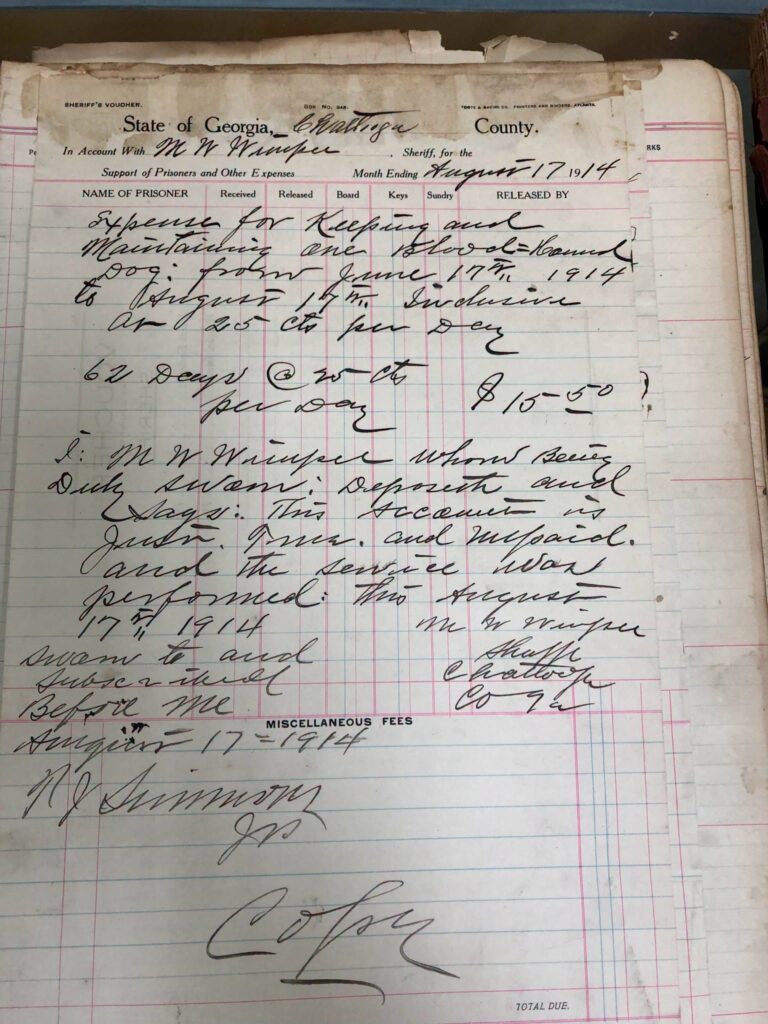
A handwritten receipt shared last week on social media by the Chattooga County Historical Society provides a fascinating glimpse into law enforcement in Chattooga County more than a century ago — and connects with one of the county’s most dramatic crimes of the era.
The document is a sheriff’s voucher from 1914 associated with Chattooga County Sheriff M.W. Wimpee. Among the expenses listed is the cost of keeping and maintaining a bloodhound dog from June 17 through August 17, 1914.
The county was charged 25 cents per day for 62 days, bringing the total bill for keeping the dog to $15.50.
The bloodhound is an especially interesting part of the record because tracking dogs had played an important role earlier that year in the investigation of the Bank of Lyerly robbery.
The Bank Of Lyerly Robbery
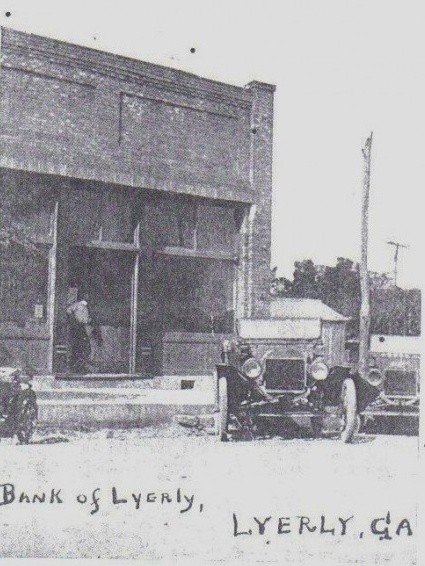
In the early morning hours of January 30, 1914, burglars attacked the Bank of Lyerly, using explosives to blow open the bank safe and escaping with approximately $4,000 in cash and valuable papers.
The crime was anything but quiet.
Historical accounts say Mrs. J.M. Rose, who lived near the bank, heard suspicious activity and initially believed someone was prowling around her property. She fired shots in an effort to frighten the intruders away.
Instead, the burglars returned fire and ordered her back into her house.
After learning of the robbery, Sheriff Wimpee called for assistance, and bloodhounds were brought from Chattanooga to help track the suspects.
Chattanooga’s Famous Bloodhound Officer
Historical records show that Perry W. Phipps, also identified in period records as P.W. Phipps, was a veteran Chattanooga law officer who had become well known throughout the region for tracking criminals with trained bloodhounds.
Phipps had been working with tracking dogs for decades by the time of the Lyerly robbery.
An 1894 newspaper account described one of Phipps’ dogs as an already-famous Chattanooga Police Department bloodhound. In that case, Phipps accompanied the dog as it followed the trail of a burglar for more than 20 miles after a railroad depot and post office were robbed.
A later Chattanooga history described Phipps as a veteran lawman whose specialty was detecting criminals with highly trained English bloodhounds. His services and those of his dogs were called upon well outside Chattanooga and Hamilton County.
Historical accounts of the Lyerly robbery say a Chattanooga officer named Phipps arrived with his famed bloodhounds following the bank robbery. The dogs picked up a trail at the bank and followed it toward the railroad depot and then southwest toward Dirtseller Mountain.
Along the route, investigators reportedly discovered bank papers and a bottle of nitroglycerin. Near the foot of Dirtseller Mountain, the search party found dynamite and fuses near an old outbuilding.
The trail eventually led investigators toward the home of Mark McNew, a miner who lived on Dirtseller Mountain. A subsequent search reportedly uncovered papers belonging to the Bank of Lyerly.
Arrests And A Complicated Court Case
The investigation ultimately resulted in arrests and a court case that attracted attention well beyond Chattooga County.
Mark McNew and Frank Mathews were convicted in Chattooga Superior Court in connection with the robbery. Banking industry records from 1914 also document their arrests and convictions for burglarizing the Lyerly bank.
But the case became increasingly complicated.
McNew had implicated Mathews in the robbery, but later repudiated his confession amid allegations that he had been offered immunity and a $500 reward for his testimony.
Mathews was seriously ill with tuberculosis during the proceedings. He died in June 1914 after being convicted and sentenced to 10 years. In a statement shortly before his death, Mathews maintained his innocence and also said McNew was innocent.
Years later, McNew received a pardon.
Sheriff Wimpee And The Bloodhound
The handwritten voucher shared by the Chattooga County Historical Society brings the story back to Sheriff M.W. Wimpee.
The document shows that only months after the Bank of Lyerly robbery and the use of bloodhounds during the investigation, Chattooga County was paying its sheriff to keep and maintain a bloodhound.
The voucher covers the period from June 17 through August 17, 1914 — just months after the January bank robbery.
The surviving records do not conclusively establish that the bloodhound being maintained by Sheriff Wimpee that summer was one of the same dogs used during the Bank of Lyerly investigation. But taken together, the records illustrate how important tracking dogs were to law enforcement during the period.
The old receipt also provides an interesting glimpse into the cost of operating the sheriff’s office in 1914: 62 days of keeping and maintaining a bloodhound cost Chattooga County $15.50.
Wimpee’s tenure as sheriff would end later that same year. Contemporary reporting shows that M.W. Wimpee resigned as Chattooga County sheriff in December 1914 because of ill health. Coroner John E. Dalton temporarily filled the office until Sheriff-elect J.W. Alexander took office.
More than a century later, one handwritten receipt preserved and shared by the Chattooga County Historical Society opens a window into a remarkable chapter of local history — a dynamited bank safe in Lyerly, gunfire in the middle of the night, a posse headed toward Dirtseller Mountain and bloodhounds following the trail.
And just a few months later, Chattooga County still had a bill to pay for keeping a bloodhound ready for the next trail.
Comments