






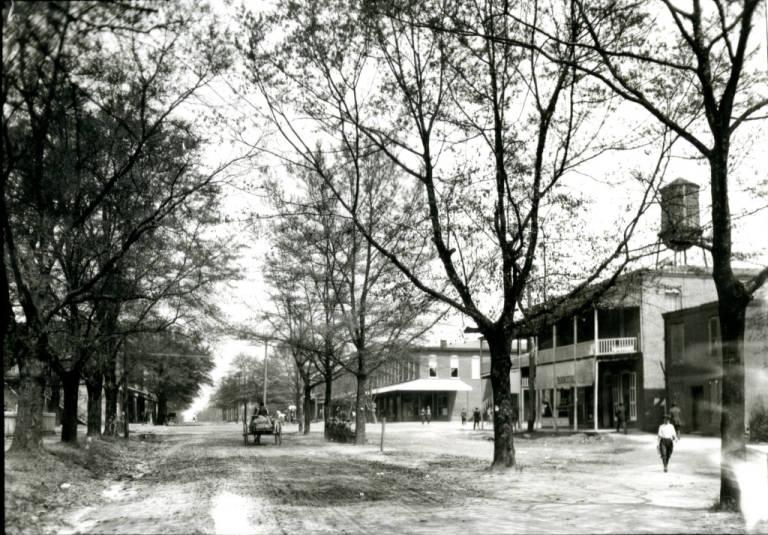
An early view of Commerce Street in downtown Summerville, Georgia, around the turn of the 20th century. Originally established as Selma in 1839, the community was renamed Summerville in 1840 and grew into the center of government and commerce for Chattooga County.
The city of Summerville has served as the county seat of Chattooga County for more than 185 years, but many residents may not realize that the community originally had a different name. When the town was established in 1839, it was known as Selma, a name that remained in use for less than a year before being changed to Summerville.
The story begins with the creation of Chattooga County on December 28, 1838, when Georgia Governor George Gilmer signed legislation establishing the new county from portions of Floyd and Walker counties. With a new county government to organize, local leaders needed a permanent location for a courthouse and other government business. On March 23, 1839, a 90-acre tract of land was purchased from John F. Beavers for $1,800 to establish the county seat. That property became the foundation of the town that would eventually develop into modern-day Summerville.
According to historical records preserved by the Chattooga County Historical Society, the new community was called Selma beginning April 16, 1839. The name remained associated with the settlement until March 11, 1840, when the post office name was changed to Summerville. Although the community’s original name disappeared relatively quickly, the change became one of the earliest milestones in the development of Chattooga County’s seat of government.
Exactly how the name Summerville was chosen has been the subject of historical discussion. One explanation suggests that the name reflected the area’s favorable summer climate, particularly when compared with the warmer lowlands of Georgia. Another account connects the name to David Taylor Jr., an influential early settler and civic leader who reportedly maintained a summer residence at a place called Summerville near Augusta. Both explanations appear in accounts of the community’s early history, although neither has been conclusively established as the reason for the name change.
During the decades that followed, Summerville grew from a small frontier county seat into a center of government, business and transportation. The arrival and expansion of railroad service helped connect the community with markets beyond Chattooga County, while merchants and other businesses established themselves around the courthouse square. Buildings that remain part of the city’s historical landscape reflect that growth, including the Arrington Building, constructed in 1896, the Chattooga County Courthouse, completed in 1909, and the Central of Georgia Railroad Depot, dating to 1918.
The original 90-acre town established in 1839 eventually expanded far beyond the boundaries envisioned by its founders. Summerville became home to generations of families, businesses, churches and civic institutions, while continuing to serve as the administrative center of Chattooga County. Its development mirrored many of the changes experienced throughout Northwest Georgia, from the agricultural economy of the nineteenth century to the industrial growth and transportation improvements of the twentieth century.
Today, the name Selma is largely forgotten in everyday conversation, but it remains an important part of Summerville’s earliest history. The community that began with a $1,800 land purchase in 1839 has now carried the name Summerville for more than 186 years, a reminder that even the most familiar places sometimes have beginnings that are less familiar than we might imagine.
Comments