










Long before manufacturing became a major part of Chattooga County’s economy, people looked to the mountains and ridges surrounding the county for another source of economic development — minerals buried beneath the ground.
Mining never dominated Chattooga County to the degree that textiles later would, but iron ore, coal, marble and chert all became part of the county’s economic history. The New Georgia Encyclopedia specifically identifies all four as minerals extracted in Chattooga County.
The story stretches from the iron mines of the 19th and early 20th centuries to strip mining for coal around Cloudland on Lookout Mountain that continued into the 1980s.
Iron Ore And The Search For Mineral Wealth
By the late 1800s, local residents were well aware of the mineral resources lying beneath Chattooga County.
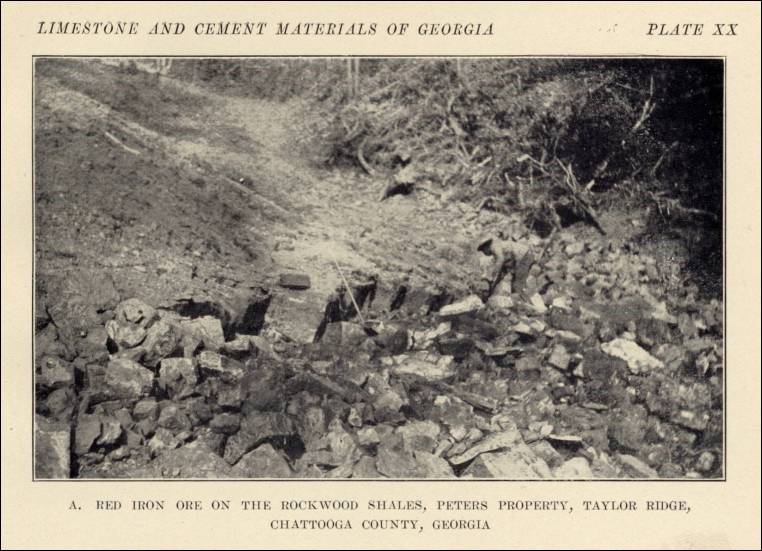
An 1888 edition of The Chattooga News described deposits of iron ore, marble, ochre and kaolin, while also noting the possibility of coal on Lookout Mountain. The newspaper described iron deposits around Dirtseller Mountain, Taylor Ridge and Shinbone Mountain and promoted the county’s mineral wealth as a potential source of future industrial development.
Iron ore became one of the more visible mining operations.
One important area was Taylor Ridge. According to the Chattooga County Historical Society, iron ore was mined for a period on the Rome side of Taylor Ridge during the early 1900s. An entire small community called Shackelton developed to support the mining operation. By around 1920, however, the mining had played out and the community largely disappeared with it.
Mining and prospecting also occurred elsewhere.
An early Georgia Geological Survey documented old iron workings near the base of Lookout Mountain, including properties south of the Chattooga-Walker County line and near Chelsea. Geological investigators found several beds of fossil iron ore, although many were relatively thin.
But perhaps the most unusual chapter in Chattooga County mining history involves coal.
Georgia’s Coal Country Was In The Extreme Northwest Corner Of The State
Coal is not spread throughout Georgia as it is in neighboring Alabama and Tennessee.
Georgia Geological Survey records show that the state’s coal deposits are confined to the extreme northwestern corner of Georgia — historically identified with Lookout, Sand and Pigeon mountains in Chattooga, Walker and Dade counties. The state’s entire coal-bearing area was estimated at only about 170 square miles.
That geological distinction is why Lookout Mountain is the only part of Chattooga County — and part of Georgia’s very small northwestern coal field — where mineable coal occurs.
In Chattooga County itself, the coal-bearing formations occupy only a small area in the northwestern corner of the county near the Alabama state line, primarily around Lookout Mountain and Cloudland. Geological studies describe the local seams as generally thin and irregular.
And people knew about the coal for a very long time.
Georgia’s coal-mining history predates the Civil War. Early coal from the Lookout Mountain region was mined on a limited basis and used locally, including as fuel in blacksmith forges.
By the turn of the 20th century, coal mining had become a substantial industry farther north around Durham in Walker County. The arrival of a railroad helped transform those mines into a major operation. Around the turn of the century, Durham was producing roughly 1,000 tons of coal per day, and much of it was converted into coke at ovens near Chickamauga.
Chattooga County’s deposits, however, were more difficult to develop commercially.
A 1910 Georgia mineral-resource report said coal exposures in Chattooga County were concentrated along the eastern brow of Lookout Mountain, generally 500 to 600 feet above the valley. At that time, prospecting had occurred but the county had not yet developed the kind of commercial coal production found farther north.
One early prospect was on Trion Factory property atop Lookout Mountain. Geological investigators found that considerable exploratory work had been done there in hopes of locating a workable seam. Shallow cuts had been opened, and pieces of bright coal and black shale could still be found around the old workings when state geologists examined the site.
Coal Mining Comes To Cloudland
Eventually, commercial coal mining did become a reality in Chattooga County.
By the 1970s, strip mining was taking place around Cloudland on Lookout Mountain.
A particularly valuable historical record comes from a Georgia Geological Survey study of coal resources on Lookout and Sand mountains.
On August 31, 1977, geologists collected a coal sample from the highwall of an active strip mine less than a mile north-northeast of Cloudland. The report identifies the operator as William “Bill” Selman Jr. of Summerville.
The following day, geologists examined another operation approximately three miles north of Cloudland identified as the Lookout Mountain Coal Company, Chattooga No. 1 Mine.
Those records provide unusually specific evidence of active coal mining in Chattooga County during the late 1970s.
And the industry wasn’t merely a brief operation.
A February 1983 Summerville News report stated that strip mining for coal in the Cloudland area had been underway for more than a decade. The newspaper described Lookout Mountain’s product as a high-quality metallurgical coal with low sulfur content.
Metallurgical coal differs from ordinary heating coal because certain grades can be used in industrial processes associated with iron and steel production.
Mining on the mountain involved removing the earth and rock above relatively shallow coal seams rather than driving the extensive underground shafts associated with many Appalachian coal mines.
The seams themselves could be surprisingly thin.
Geologists examining Chattooga County reported coal beds generally ranging from about 10 to 18 inches thick in prospect openings, although individual formations varied considerably.
By The 1980s, The Story Turned To Reclamation
By the early 1980s, some mining sites around Cloudland had already been abandoned.
In September 1981, state geologists examined an abandoned strip mine about two miles north of Cloudland. They documented exposed coal in the mine’s highwall, providing another physical record of the mining activity that had taken place there.
By 1984, attention was increasingly turning from extracting coal to repairing the landscape left behind.
An August 1984 edition of The Summerville News reported that the U.S. Office of Surface Mining was carrying out reclamation work on former strip-mined land near Cloudland. One project involved an old mining area near Little River, approximately two miles north of Camp Juliette Low. Federal officials had completed work involving a sediment pond considered dangerous and expected additional reclamation work in the area.
So the remnants visible on portions of Lookout Mountain today are not simply unusual cuts in the landscape. Some are evidence of a relatively recent industry that operated within the memory of many Chattooga County residents.
A Forgotten Part Of Chattooga County’s Industrial Story
Chattooga County was never destined to become another major Appalachian coal-producing region. The geology simply wasn’t favorable enough. The county’s coal-bearing area was small, the seams were often thin and irregular, and extracting the coal could be expensive.
But mining remains an important part of the county’s history.
Today, most people driving through Cloudland or looking across the wooded top of Lookout Mountain probably don’t think of Chattooga County as coal country. But within the lifetime of many people still living here, it was. In the 1970s, strip mines operated on the mountain, heavy equipment moved across land where families had once farmed, coal was stockpiled for shipment, and as many as 100 people were employed in Chattooga County’s coal industry. State geologists came to Cloudland to study the seams, and local newspapers regularly reported on mining and reclamation.
Eventually, the mining stopped. The equipment disappeared, reclamation began and vegetation reclaimed much of the disturbed ground.
But the coal is still there.
Beneath portions of Lookout Mountain are seams that make this corner of Northwest Georgia geologically different from almost every other part of the state.
It is a largely forgotten chapter of Chattooga County history — a time when Cloudland wasn’t simply a mountain community….it was coal country.
Comments