









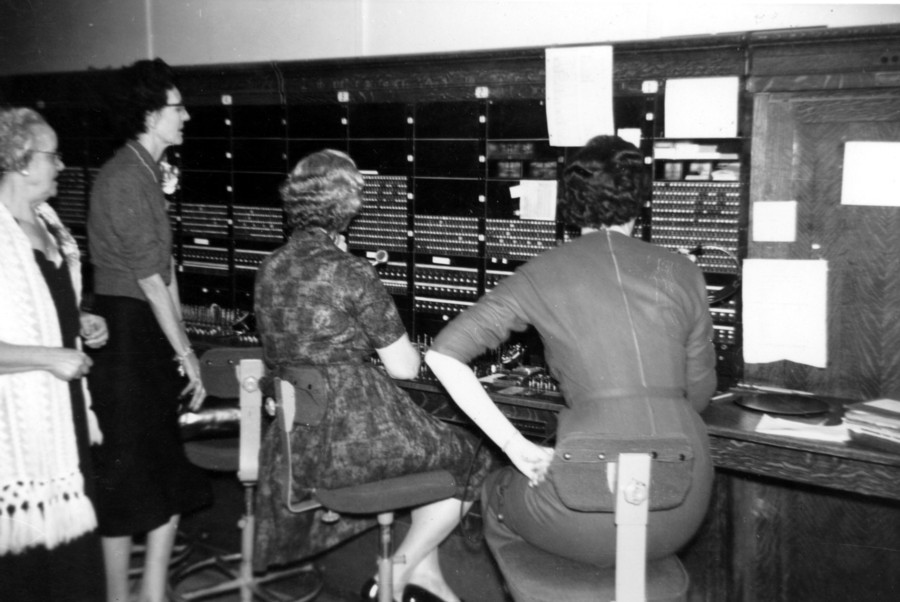
Telephone operators at the Summerville Telephone Company on the final day of operator-assisted telephone service in 1960. Direct dialing began the following day. (Photo courtesy of Ben Bridges/Chattooga Photo History)
For people living in Chattooga County today, flipping a light switch or making a telephone call is so ordinary that little thought is given to either one.
But a little more than a century ago, both represented technologies that were beginning to fundamentally change everyday life.
There was a time when darkness meant lighting an oil lamp, when many homes drew their water from wells, and when making a long-distance telephone call in Chattooga County meant traveling into Summerville and going inside a local store.
The arrival of electricity and the telephone didn’t happen everywhere at once. The technologies spread gradually through mills, businesses and towns before becoming commonplace in homes throughout the county.
And when it came to electricity, Trion was among the first places in Chattooga County to enter the electrical age.
Electric Lights Come To Trion
By the beginning of the 20th century, Trion was already a major industrial center because of its textile mill. Electricity offered something revolutionary for both manufacturing and the community surrounding the mill.
Historical accounts preserved by the Chattooga County Historical Society say electrical generation came to Trion in the early 1900s, with generating equipment installed at the mill.
But we don’t have to rely entirely on histories written decades later.
We have a newspaper account from 1905 itself.
On March 16, 1905, The Summerville News reported that Trion’s new electric-light plant had been completed and was already operating.
The newspaper said the new plant was furnishing a “brilliant light” and that the improvement was greatly appreciated by residents—adding that it would be appreciated even more when the first truly dark and rainy night arrived.
Electric lighting was still new enough in Chattooga County that turning on the lights was news.
Historical accounts also provide clues about the equipment being used at Trion. One account preserved by the Chattooga County Historical Society describes a mill employee helping install the electrical plant’s dynamos and later taking charge of operating them.
A dynamo was an early electrical generator, converting mechanical energy into electrical energy.
Together, those records give us a clearer picture of Trion’s entry into the electrical age: generating equipment was installed, dynamos were being operated, and by March 1905 an electric-light plant was illuminating the village.
Summerville Looks Toward Electricity
Summerville wasn’t far behind.
In 1907, a group of businessmen organized a company intended to provide electric power in Summerville. According to historical accounts, that first effort never got off the ground.
Nearly a decade passed before another serious attempt was made.
In 1916, Summerville businessmen paid for a survey to determine what it would cost to install an electrical system.
That effort resulted in the creation of the City Light and Power Company, which provided electricity to the Summerville Cotton Mill along with limited electrical service in town.
The word “limited” is important.
Electricity didn’t suddenly appear in every house simply because generating equipment existed. Extending electrical service required poles, wires, distribution equipment and considerable investment.
For years, the old and new ways of life existed side by side.
By 1922, another major step had been taken when Summerville granted the Georgia Railway and Power Company a franchise to establish an electrical distribution system in town.
Gradually, electricity was becoming part of everyday life.
But another technological revolution had actually reached Chattooga County even earlier.
One Telephone For Long-Distance Calls
The first documented long-distance telephone connection in Chattooga County arrived in 1902.
There was just one telephone connected to it.
AT&T installed the connection to a telephone located inside Thompson Hiles’ store in Summerville. Anyone wanting to make a long-distance telephone call had to travel to the store to use it.
Think about that for a moment.
Today almost everyone carries a telephone wherever they go. In 1902, having access to a long-distance telephone in Chattooga County could mean going into Summerville and walking into a particular business.
Still, local telephone service began developing quickly.
By 1904, both Summerville and Menlo had independent telephone systems. Menlo’s early system apparently didn’t last, and by 1909 the Summerville Telephone Company was putting up poles for a telephone line to Menlo.
Telephone development wasn’t limited to the larger communities.
In 1912, the Farmers Telephone Company was chartered to provide service between Lyerly and Menlo. Over time, telephone systems served communities including Summerville, Trion, Gore, Lyerly and Menlo.
Before You Could Just Dial A Number
Early telephone service bore little resemblance to what came later.
For many calls, the key person wasn’t the caller—it was the telephone operator.
A caller contacted a central exchange, where an operator physically connected the appropriate lines through a switchboard.
Operators became familiar voices in communities across America, including Chattooga County. They connected businesses, families and emergency calls long before anyone could simply punch a telephone number into a cellphone.
Telephone service wasn’t necessarily available around the clock, either.
Historical accounts of Chattooga County’s early systems say subscribers were expected to restrict calls after 9 PM and on holidays to emergencies.
It was a very different communications world.
But there’s another part of the old telephone system that many Chattooga County residents don’t have to read about in a history book.
They remember it themselves.
Remember The Party Line?
Mention a party line to younger people today and they may have no idea what you’re talking about.
Mention it to many older Chattooga County residents and you’re likely to get a story.
For decades, particularly in rural areas, several households could share the same telephone line.
Instead of every home having an entirely private connection, several families were connected to the same circuit. Depending on the particular system, households could have distinctive ringing patterns so families knew whether an incoming call was intended for them.
There was one obvious drawback.
Your telephone conversation wasn’t necessarily private.
If another person sharing the party line picked up the receiver while you were talking, they could potentially hear your conversation.
Good telephone etiquette meant hanging up when you realized someone else was using the line.
Of course, plenty of people who grew up with party lines can probably remember at least one neighbor who didn’t always follow that rule.
There was another frustration.
Only one conversation could use the shared line at a time. If somebody was having a particularly long conversation, everyone else sharing the line had to wait.
Party lines nevertheless made telephone service more practical in rural areas where homes could be separated by considerable distances.
And we have documentation showing just how common they remained in Chattooga County in the early 1960s.
One-Party, Two-Party, Four-Party — And Rural Multiparty
A 1961 Summerville Telephone Company rate notice published in The Summerville News provides a fascinating snapshot of local telephone service.
Customers served by the company’s Summerville, Menlo and Lyerly exchanges could choose from several different classes of service.
Residential customers could have a private one-party line, a two-party line or a four-party line.
There was also a separate category called “Rural Multiparty” service.
The price reflected how much privacy you wanted.
In 1961, residential one-party service was listed at $4 per month, with the company proposing an increase to $4.50. Two-party residential service cost $3.25, while four-party service was $2.75 per month.
Rural multiparty residential service started at $2.75 per month for customers within two miles, with an additional charge for greater distances.
Trion had its own telephone company at the time, and its 1961 rate schedule was published alongside Summerville’s.
The Trion Telephone Company offered one-party, two-party, four-party and even five-party residential lines, along with rural multiparty service.
So the party line wasn’t simply something remembered from the distant past. In 1961, it was an ordinary and officially priced part of telephone service in Chattooga County.
Party Lines Survived For Decades
Even as private telephone lines became increasingly common, party lines didn’t disappear everywhere at once.
They survived much longer in some rural areas where the expense of installing individual lines to widely scattered homes made shared service practical.
And here in Chattooga County, party-line service survived at Cloudland into the 1990s.
That means some residents on Lookout Mountain were still sharing telephone lines with neighbors at a time when cellular telephones were already beginning to appear.
For families who experienced it, the party line remains one of the most memorable pieces of rural telephone history—the distinctive rings, waiting for someone to finish talking and occasionally wondering whether someone else had quietly picked up the receiver.
The Telephone Companies Change
The companies providing telephone service changed considerably as the system modernized.
The Summerville Telephone Company and Trion Telephone Company were still operating as separate companies in 1961.
Georgia Public Service Commission records show that General Telephone Company of Georgia sought authority in late 1961 to acquire telephone companies serving communities that included Summerville, Lyerly, Menlo and Trion.
The restructuring continued in 1962.
Public Service Commission records show General Telephone received approval for a corporate reorganization involving several telephone companies, including the Summerville Telephone Company and Trion Telephone Company.
A later Summerville News account from 1981 described the Summerville Telephone Company as a predecessor of General Telephone, or GTE, and said General Telephone acquired the Summerville company in 1961.
By 1981, GTE’s Summerville service area included the Summerville, Lyerly, Trion and Menlo exchanges.
The company names would change again in the years that followed.
By the 1990s, ALLTEL was providing local telephone service in Chattooga County. A 1994 ALLTEL notice published in The Summerville News instructed Chattooga County customers that payments could be made at Farmers & Merchants Bank locations in Summerville, Trion, Lyerly and Menlo.
The technology had changed enormously, but those same community exchanges remained part of the local telephone network.
Electricity Changes More Than The Light Bulb
Electricity ultimately changed far more than the way Chattooga County residents illuminated their homes.
It transformed manufacturing.
Electric motors eventually powered equipment that previously depended on other forms of mechanical power. Electricity made it easier for factories and businesses to operate after dark.
Then came changes inside the home.
Electric appliances reduced some of the physical labor that had consumed hours of everyday life. Refrigeration transformed food storage. Electric pumps changed how water could be moved. Radios brought voices, music and news from far beyond Chattooga County directly into people’s homes.
And eventually, electricity would power the technology that transformed the telephone itself.
From One Telephone To A Phone In Every Pocket
The transformation is extraordinary when viewed across little more than a century.
In 1902, the county’s first documented long-distance telephone connection led to a single telephone in Thompson Hiles’ store in Summerville.
By March 1905, The Summerville News was telling readers that Trion’s new electric-light plant had been completed and was furnishing a brilliant light to the village.
Soon came telephone poles stretching between communities, independent exchanges, switchboard operators and electrical distribution systems.
Then came private residential telephones, direct dialing and increasingly widespread electrical service.
But the old technology didn’t disappear overnight.
As late as 1961, local telephone companies were openly advertising rates for two-party, four-party, five-party and rural multiparty telephone service.
And in some rural areas, party lines lasted for decades afterward—including at Cloudland into the 1990s.
Today, the telephone and electricity have become so thoroughly intertwined with everyday life that it’s difficult to imagine Chattooga County without either one.
A device small enough to fit in a pocket can make a telephone call, take a photograph, play music, receive breaking news and communicate instantly with someone thousands of miles away.
Yet the story of that technological transformation in Chattooga County began much more simply.
It began with one long-distance telephone in a Summerville store.
And in Trion, it included dynamos and an electric-light plant that The Summerville News was excitedly telling its readers about in 1905.
For older residents who still remember waiting for a neighbor to get off the party line, some chapters of that history don’t seem very long ago at all.
Sources
The Summerville News, March 16, 1905 — Contemporary report announcing completion of Trion’s new electric-light plant and describing the light it provided to the village. Georgia Historic Newspapers, Digital Library of Georgia.
Chattooga County Historical Society — Historical accounts of the arrival and development of electricity and telephone service in Chattooga County, including Trion’s electrical plant and dynamos, Summerville’s early electrical development, the 1902 long-distance telephone connection at Thompson Hiles’ store, and the development of community telephone systems.
The Summerville News, June 1, 1961 — Summerville Telephone Company and Trion Telephone Company rate notices documenting one-party, two-party, four-party, five-party and rural multiparty telephone service in Chattooga County.
Georgia Public Service Commission, 1961 Annual Report — Records concerning General Telephone Company of Georgia’s acquisition of telephone companies serving Summerville, Lyerly, Menlo, Trion and other Georgia communities. Digital Library of Georgia.
Georgia Public Service Commission, 1962 Annual Report — Records documenting the subsequent consolidation and liquidation of the Summerville Telephone Company, Trion Telephone Company and other telephone companies into the General Telephone corporate system. Digital Library of Georgia.
The Summerville News, July 23, 1981 — Report identifying the Summerville Telephone Company as a predecessor of GTE and describing General Telephone’s Summerville, Lyerly, Trion and Menlo service area.
The Summerville News, August 18, 1994 — ALLTEL customer notice documenting ALLTEL telephone service in Chattooga County and payment locations in Summerville, Trion, Lyerly and Menlo.
Additional Local Historical Information: The recollection that party-line telephone service remained in use at Cloudland into the 1990s comes from firsthand knowledge of residents who used the service.
Comments