










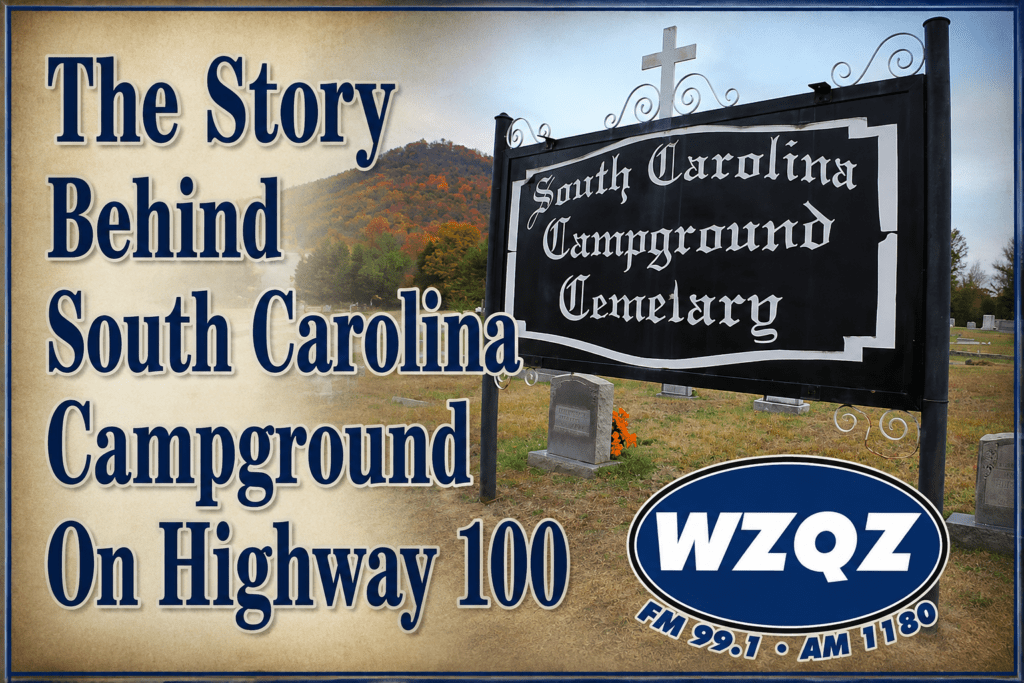
Motorists traveling Georgia Highway 100 between Summerville and the Floyd County line pass a place whose unusual name reaches deep into Chattooga County’s earliest history.
South Carolina Campground sits near the southern end of Taylor’s Ridge in the High Point area. To someone unfamiliar with the community, the name might seem out of place. After all, the South Carolina state line is many miles away.
But the name is a reminder of the families who settled this portion of Chattooga County during the 1800s — and of a time when a rural campground could serve not only as a place of worship, but as a school, meeting place, cemetery and center of community life.
Records indicate the history of South Carolina Campground stretches back to the 1840s, only a few years after Chattooga County itself was created in 1838.
Why Is It Called South Carolina Campground?
The answer appears to be surprisingly straightforward: South Carolinians came here.
A history of South Carolina Campground Methodist Church written in 1959 by the Rev. Charles Hendrix says many of the early members of the congregation had migrated into Chattooga County from South Carolina. Over time, their meeting place became known as South Carolina Campground.
One family history provides additional detail. It says Little Berry Strange, born in South Carolina in 1807, came to Chattooga County with his family in 1841 and settled near Broomtown at the foot of Taylor’s Ridge. According to that account, Strange and his brother, William Bradford Strange, helped establish a church, school, cemetery and camp-meeting ground that became South Carolina Camp Ground.
While family histories should be treated differently from contemporary public records, this account fits closely with the surviving church history and later newspaper records.
Before South Carolina Campground, There Was Ewing’s Chapel
The congregation apparently wasn’t originally called South Carolina Campground Methodist Church.
Its earlier name was Ewing’s Chapel, believed to have been named for the Rev. J.H. Ewing.
Ewing served the Summerville Methodist Circuit in 1848 and 1849, and Ewing’s Chapel was among the churches on the circuit.
That puts an organized Methodist presence at the campground by at least 1848.
The timing is significant. Chattooga County had existed for only about a decade. Summerville itself was still a very small county seat, and much of the county consisted of farms connected by primitive roads.
Churches were among the most important institutions in rural communities. They were places of worship, certainly, but often much more. They provided meeting places, social connections and community organization for families who might otherwise live miles apart.
And a camp meeting could bring together people from across a much wider area.
The Camp-Meeting Tradition
Camp meetings were an important part of American Protestant life during the 19th century, particularly across the South and the frontier.
Families sometimes traveled considerable distances and remained at a campground for several days while preachers conducted repeated worship services and revivals.
Before automobiles and modern highways, attending such a meeting could be a major undertaking. People came by wagon, horseback or on foot. Early camp meetings could include temporary shelters and tents, with worship continuing for days.
South Carolina Campground grew out of that religious tradition.
The 1959 history remembers the campground as a place known for large revivals and strong attendance, with worship characterized by preaching, singing, prayer and personal testimony.
Among the ministers remembered in connection with especially successful revivals were Richard Harrell, Osgood Haygood and O.A. Thrower.
An 1849 Deed Gives Us A Firm Date
One of the strongest pieces of documentary evidence for the campground’s early history comes from January 26, 1849.
On that date, Jonas McClung conveyed property for use by trustees associated with the Methodist Episcopal Church, South.
The trustees named in the historical account were S. Calhoun, James McCollum, J.B. Knowles, R.R. Carr, James Smith, L.B. Strange, James Sturdivant, Jonas McClung and Floyd S. Hudgins.
The deed contained an important condition: the property was intended for religious purposes and could revert to the McClung estate if it ceased being used for public worship.
The appearance of L.B. Strange among the trustees is noteworthy because it appears consistent with the family account identifying Little Berry Strange as one of the people involved in establishing the campground.
Together, the records paint a picture of several early Chattooga County families joining together to establish a permanent religious institution.
The First Church Was Made Of Logs
The first known church building at South Carolina Campground was a log structure built in 1849.
That building served the congregation for more than 20 years.
Then, in 1872, the log church was removed and replaced with a large white-frame church constructed by John Rivers.
When Rev. Hendrix prepared his history in 1959, that 1872 church was still standing and serving the congregation — meaning the building was already approximately 87 years old at the time.
Other property was gradually added to the grounds.
The historical record notes an 1873 transaction involving William P. Bowles and approximately four acres containing the church and graveyard. In 1892, J.W. McCollum conveyed another roughly three-and-a-half acres, including property around the spring.
By 1959, South Carolina Campground consisted of approximately seven-and-a-half acres, including the church, cemetery, wooded property and a spring near the foot of the hill.
There Was A School At South Carolina Campground
The campground wasn’t used exclusively for church services.
Old Chattooga County newspapers provide compelling evidence that there was also an academy — essentially a school — at South Carolina Campground.
In March 1877, The Summerville Gazette listed meetings of Cold Water Grange No. 545, part of the Patrons of Husbandry, or Grange movement.
The newspaper said the organization met on the third Saturday of each month in the academy at South Carolina Camp Ground.
William Morgan was listed as master and John W. McCollum as secretary.
That small newspaper notice tells us quite a bit.
By the 1870s, South Carolina Campground wasn’t merely a location where people gathered occasionally for revival meetings. It was a recognizable community center with an educational building capable of hosting civic and agricultural organizations.
For rural families in that era, church, school and community life were often intertwined.
The Name Once Identified An Entire Area
Today, people generally think of South Carolina Campground as a particular historic site or cemetery.
A century ago, however, the name could describe an entire section of Chattooga County.
A 1920 property notice in The Summerville News, for example, described land near the Chattooga River by referring to the public road leading from Summerville to South Carolina Camp Ground.
That is significant.
People evidently understood exactly where that road went without further explanation. Long before modern highway numbers became the way people described travel routes, South Carolina Campground itself was a destination and geographical reference point.
Today’s Highway 100 corridor would have looked dramatically different then — a rural road serving farms, churches and small communities rather than the paved state highway motorists know today.
Generations Were Buried At The Campground
The cemetery became one of South Carolina Campground’s most enduring features.
Old newspapers repeatedly record funerals and burials there.
In 1910, The Summerville News reported that Oliver Crumley, who had died near Trion, was brought to Lyerly and then carried to South Carolina Campground for burial.
In 1928, the newspaper reported the death of Mrs. T.J. Kendrick, an 80-year-old pioneer Chattooga County resident. Her funeral was conducted at South Carolina Camp Ground Methodist Church, which the newspaper described as three miles east of Lyerly, and she was buried in the campground cemetery.
In 1931, the funeral of Nina Scoggins Stephenson, wife of J. Griff Stephenson of the Coldwater District, was held at South Carolina Camp Ground.
A decade later, in September 1941, the newspaper reported the graveside funeral of two-month-old Larry Rogers Espy in South Carolina Camp Ground Cemetery.
Those are only a few examples.
Taken together, the notices demonstrate that the campground cemetery served families across generations and became a final resting place for residents from the surrounding communities.
Caring For The Cemetery Was A Community Responsibility
Old newspaper notices also show how maintaining the cemetery became a shared responsibility.
There were no landscaping companies arriving every week to maintain an old rural cemetery.
Instead, people gathered and did the work themselves.
In August 1948, The Summerville News announced that South Carolina Camp Ground Cemetery would be cleaned beginning Friday morning, August 20.
Those who could not attend or send someone to help were asked to make a financial contribution to J.B. Vaughn or Clyde Stephenson of Lyerly Route 1.
That notice provides a glimpse into a tradition once common throughout rural Northwest Georgia: designated cemetery-cleaning days when descendants and neighbors gathered with tools to cut weeds, clear brush and care for family graves.
The practice was about more than maintenance. It was also a connection between living families and the generations who had come before them.
South Carolina Campground And The Methodist Church
For its early history, South Carolina Campground was part of the Summerville Methodist Circuit.
It remained on that circuit until 1897, when it was transferred to the Lyerly Charge.
The Rev. M.L. Troutman Jr. became the first pastor listed as serving South Carolina Campground under the Lyerly Charge.
The surviving history contains a remarkable list of ministers stretching from J.H. Ewing in 1848-49 through more than a century of Methodist ministry.
That continuity means generations of Chattooga County families heard sermons, attended revivals, married, mourned relatives and worshipped on those grounds.
By The 1950s, The Old Rural Church Was Struggling
Like many rural congregations, South Carolina Campground eventually faced a changing world.
Population patterns changed. Transportation improved. People who once depended on small neighborhood churches could travel farther. Farms became fewer and rural families moved toward towns and employment centers.
By 1959, South Carolina Campground Methodist Church had only eight members.
Its annual pastoral salary was listed at $250, missions and benevolences amounted to $29, and its total annual budget was $394.
Sunday School had at one point been discontinued but was restarted.
And in 1957, something happened that today sounds ordinary but represented a dramatic modernization for the old country church:
South Carolina Campground got electricity.
Think about the span of history represented by that fact.
The congregation had begun in an era of log buildings, wagons and oil lamps.
More than a century later, electric lights finally illuminated the church.
Highway 100 Brought A New Era To Its Doorstep
Rev. Hendrix saw another reason for optimism in 1959.
A modern paved highway now passed the church, connecting the Summerville area toward Rome.
He believed industrial growth in Summerville and Rome might eventually result in new homes being built around South Carolina Campground and help sustain the historic congregation.
That road is part of the story, too.
The old route that newspapers once simply described as the road from Summerville to South Carolina Campground had entered the automobile age.
What had once been a rural destination important enough to give the road its identity was now sitting beside a modern highway.
The Church Was Still Active Into The 1970s
Despite the declining membership recorded in 1959, South Carolina Campground’s story did not end there.
A May 1961 community column in The Summerville News reported that Mr. and Mrs. Clyde Stephenson, Mr. and Mrs. Ben Vaughn, Mrs. Hester Clark and John Vaughn were among those attending services and dinner at South Carolina Camp Ground.
Nearly a decade later, the newspaper was still reporting gatherings there.
In June 1970, a community column noted that several residents attended a meeting at South Carolina Camp Ground Methodist Church.
That means documented religious activity at the site stretches from at least the 1840s into the 1970s — more than 120 years.
More Than An Unusual Name On Highway 100
Today, it would be easy to drive Highway 100 and pass South Carolina Campground without realizing how much Chattooga County history is concentrated there.
But consider what happened on or around those grounds.
Pioneer families worshipped there.
A log church was built there in 1849.
A white-frame church replaced it in 1872.
Children attended an academy there.
Farmers gathered there for Grange meetings.
Methodist circuit riders preached there.
Families traveled there for camp meetings and revivals.
Neighbors gathered for dinners and homecomings.
Residents organized cemetery cleanings there.
And generation after generation of Chattooga County families buried their loved ones there.
The story also helps explain one of the more unusual place names in the county.
South Carolina Campground isn’t named for where it is.
It’s named, instead, for where some of the people who built the community came from.
They carried a little piece of South Carolina with them when they migrated into the young Chattooga County in the 1840s. They established a church, school, cemetery and meeting ground near Taylor’s Ridge.
Nearly two centuries later, the name remains.
For motorists, South Carolina Campground may be another familiar landmark along Highway 100.
For Chattooga County, however, it is a surviving connection to the days when churches and camp meetings were at the center of rural life — and when the communities that became modern Chattooga County were still taking shape.
Comments