










Long before GPS, interstate highways and modern road signs, the map of Chattooga County was dotted with small communities whose names were familiar to generations of local residents.
Some survived. Others changed names or gradually disappeared.
One of the more unusual was Sprite, Georgia.
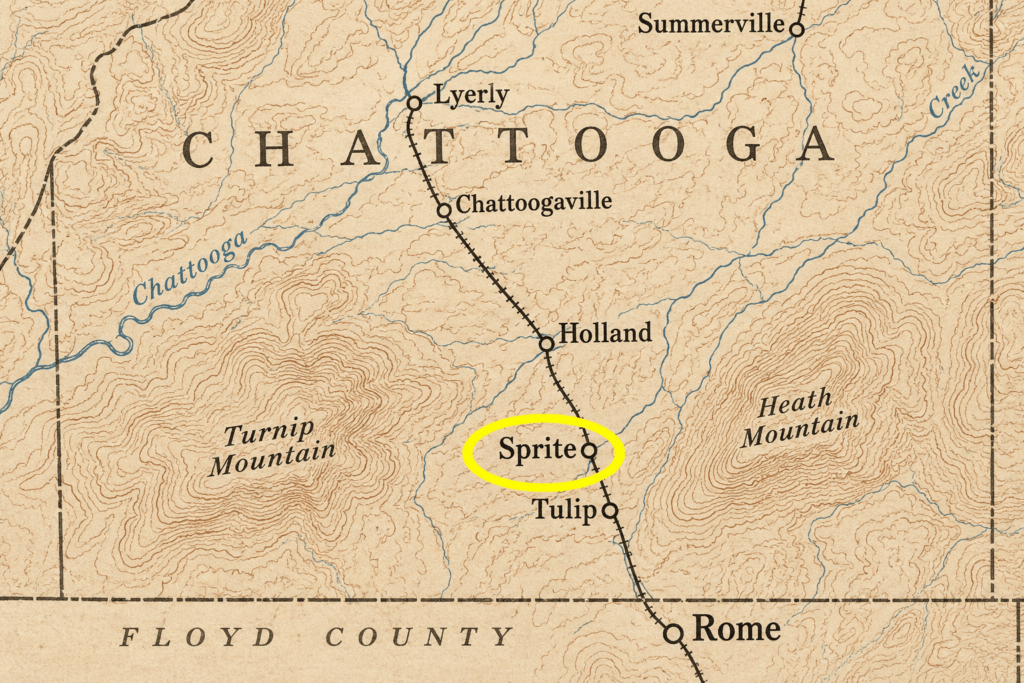
Sprite was located in southern Chattooga County in the general area between Holland and the Floyd County line. The Chattooga County Historical Society describes Sprite as a village near — and often interchangeable with — Tulip, another name once used for the community. Most importantly, Sprite was a stop on the Central of Georgia Railroad between Holland and Rome.
And Sprite wasn’t merely a name passed down through local folklore.
Historic maps document it. The Chattooga County Historical Society’s archives include an 1898 map showing the train route from Lyerly through Tulip and Sprite, while an 1898 U.S. Geological Survey map also identifies Sprite among the communities of the region.
Sprite Was A Railroad Community
The railroad was central to Sprite’s existence.
A fascinating account published in The Summerville News in 1973 looked back at the days when Tulip, Sprite and nearby Kincaid were busy places. The newspaper described Sprite specifically as the location of the railroad depot.
The railroad connected the rural farming communities of southern Chattooga County with larger markets, and one of the area’s biggest agricultural businesses was peaches.
According to the 1973 account, Hugh Miller and Addison Snooks established a large peach orchard on nearby Kincaid Mountain. During peach season, wagons carried fruit down from the mountain to the railroad.
A railroad switch extended from the main line at Sprite toward Kincaid Mountain, where peaches were stored under a large shed before being loaded into railroad cars and shipped to markets outside the area. The peach industry became large enough to employ hundreds of people, and houses were built around Kincaid and at the foot of the mountain.
That gives us a much different picture of Sprite than the quiet rural landscape someone might see there today.
At the beginning of the 20th century, trains stopped there, freight was loaded there, people lived and worked nearby, and agricultural products grown in Chattooga County left Sprite by rail for distant markets.
Tulip And Sprite
Understanding Sprite gets a little complicated because Sprite and Tulip were essentially neighboring — and sometimes interchangeable — names.
The Chattooga County Historical Society lists both communities and gives nearly identical descriptions: each was near the other, and each was associated with the Central of Georgia railroad between Holland and Rome.
The 1973 Summerville News account provides additional detail.
Tulip had the post office, while Sprite had the railroad depot.
John Holland served as postmaster at Tulip and was also the depot agent at Sprite. The Tulip community included stores, a barber shop, homes and a school.
So while people sometimes used the names almost interchangeably, they could also describe particular places or functions within the same general community.
A person might receive mail through Tulip while boarding a train or shipping agricultural products through Sprite.
People Actually Gave Their Address As Sprite, Georgia
Historic newspapers provide another interesting piece of evidence showing that Sprite was a recognized place name.
In the December 5, 1912 edition of The Summerville News, an advertisement announced a large farm sale to be held at:
“Sprite, Georgia”
The sale included mules, horses, cows, yearlings, hundreds of bushels of corn, hay, fodder, wagons, plows, farm machinery, hogs and other agricultural property.
Newspaper accounts from the period also routinely used Sprite as a geographic reference. A 1909 edition of The Summerville News, for example, reported that a man had been arrested at Sprite by a deputy sheriff.
Those references demonstrate that Sprite wasn’t simply the railroad company’s name for a siding. It was understood locally as a recognizable place.
Schools And Families At Sprite
People also made their homes there.
A reminiscence preserved by the Chattooga County Historical Society provides a direct connection to one Sprite family.
Avva Wheeler Wells, born in 1903, recalled that when she was seven years old, her grandparents Thomas King and Phydella Rush Weathers moved from Sprite, Georgia, to her father’s farm on Lyerly Highway.
The 1973 Summerville News history recalled other residents, including Will and Olla Gayler, who lived at Sprite.
Education was also part of community life. Teachers served schools around Tulip and Kincaid, and one teacher reportedly boarded with the Gayler family at Sprite while teaching nearby. Another teacher traveled to Tulip by train — something that illustrates just how important the railroad was to daily life before automobiles and school buses became commonplace.
From Kincaid To Tulip To Sprite — And Eventually Poetry
The area’s collection of names can be confusing even to people familiar with Chattooga County.
At various times, the general locality was associated with Kincaid, Tulip and Sprite.
The Chattooga County Historical Society says another name eventually appeared: Poetry.
The Historical Society describes Poetry as the latter-day name for the area that had previously been known as Sprite and Tulip.
There was even another short-lived postal name nearby.
The Historical Society records Peter as a very short-lived post office located near the Weathers home south of Holland at Sprite.
The numerous names illustrate how rural communities developed in the 19th and early 20th centuries. A community’s identity might revolve around its railroad depot, post office, store, school or a prominent local family. When those institutions moved or disappeared, the name used for the area could change as well.
The End Of Sprite As A Railroad Stop
Eventually, the economic forces that created Sprite began disappearing.
The large-scale peach business around Kincaid declined. Automobiles and improved roads reduced dependence on passenger trains. Rural schools consolidated. Small post offices closed.
And the railroad depot that had helped give Sprite its identity faded into history.
By 1973, The Summerville News summed up the change simply: Sprite had become a memory as a railroad depot. The peach shipments from Kincaid Mountain were also long gone.
Tulip’s old post office building survived longer.
According to the newspaper, Anne Clay Otwell attempted to restore the historic building, which was also locally identified as the site of an old Indian trading post. Her plans did not materialize, and the building was eventually destroyed by fire, leaving only chimneys and debris.
Sprite Hasn’t Completely Disappeared
Although there is no longer a bustling Sprite railroad depot, the name survives in historical records, maps and family memories.
Historic mapping continued to recognize Sprite long after its busiest railroad days, and the Chattooga County Historical Society has preserved photographs, maps and written accounts documenting the community.
And that’s what makes Sprite an interesting piece of Chattooga County history.
Today, someone could drive through the southern part of the county without realizing that trains once stopped nearby, hundreds of people worked in peach orchards on the mountain, wagons carried fruit to railroad cars, children attended small community schools, and residents could legitimately tell someone they lived in Sprite, Georgia.
The town didn’t move.
The landscape didn’t disappear.
The world around Sprite changed — and eventually the name nearly disappeared with it.
But more than a century later, old maps, newspapers and the memories preserved by local historians still tell the story of a little Chattooga County community that once had a place on the railroad map.
Comments