










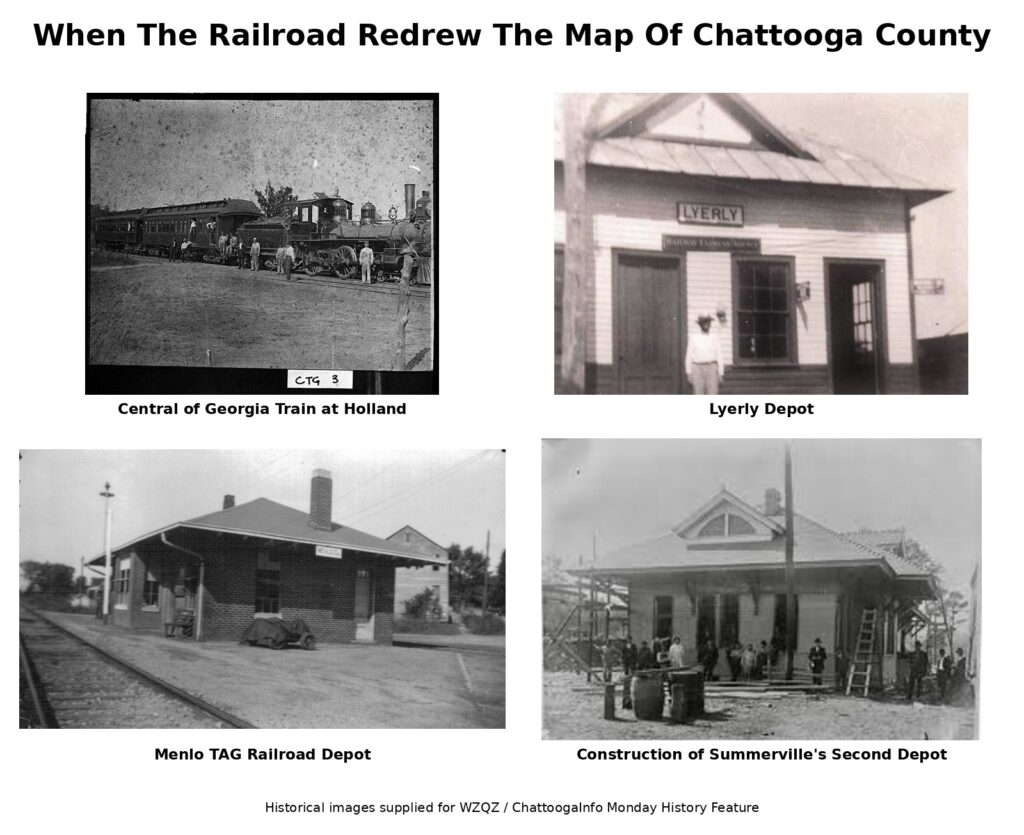
The communities we know today as Summerville, Lyerly and Menlo might look very different had railroad tracks been laid just a few miles in another direction.
When railroads finally arrived in Chattooga County during the late 1800s, they did much more than provide transportation. They determined where businesses opened, where people settled, which communities grew and, in some cases, which communities disappeared.
And at one point, the railroad nearly bypassed Summerville altogether.
The Railroad Almost Missed Summerville
Efforts to bring a railroad into Chattooga County began years before the first tracks were laid. Several proposed railroad companies came and went without ever laying rail.
That finally changed in 1888, when the Chattanooga, Rome and Columbus Railroad began coming through the county.
According to research preserved by the Chattooga County Historical Society, the original route was surveyed south from Chattanooga through Trion. From there, however, it was supposed to turn east through a gap in Taylor Ridge, enter the Dirttown Valley and continue through Armuchee toward Rome.
That route would have left Summerville without direct railroad service.
Two prominent local businessmen, John D. Taylor and C.C. Cleghorn, learned of the plans and successfully used their influence to have the route changed.
Instead of turning east after Trion, the railroad continued south through Summerville, Raccoon, Lyerly and Holland before heading toward Rome.
The decision would have a lasting effect on Summerville.
The Chattanooga, Rome and Columbus reached Chattooga County in the late 1880s, and Summerville’s first railroad depot was constructed in 1889. The railroad later became part of the Central of Georgia system.
Summerville had been the county seat since 1839, but historical accounts note that the town’s significant growth came only after the long-awaited railroad arrived.
A Railroad Creates Lyerly
Farther south, the arrival of the railroad resulted in something even more dramatic — the creation of a new town.
Before Lyerly, one of the established communities in that portion of Chattooga County was Melville, located west of the Chattooga River south of present-day Lyerly.
When the railroad came through in 1888, Angus McLeod donated land for a railroad depot. Town lots were laid out around the new station, and the community that developed there became Lyerly.
The town was named for Captain Charles A. Lyerly, an influential Chattanooga banker.
As businesses and residents gravitated toward the railroad, Melville declined. Its post office closed in 1889 after approximately 40 years of existence, and Lyerly ultimately absorbed and replaced the older community.
Lyerly was incorporated in 1891.
It is a striking example of how quickly the railroad could change the fortunes of a community. A place that had existed for decades faded while a new town grew around a railroad depot less than a mile away.
Menlo And Alpine Experience A Similar Change
Only a few years later, essentially the same thing happened on the western side of Chattooga County.
The Chattanooga Southern Railroad arrived in 1891. Its 93-mile route between Chattanooga and Gadsden passed through the area that became Menlo.
The railroad had been constructed largely to transport iron ore, timber and coal from Lookout Mountain, although it also carried passengers.
Before the railroad, Alpine had been the more established community.
But the railroad bypassed Alpine.
Instead, the tracks passed near property belonging to Captain Andrew J. Lawrence, who became instrumental in developing Menlo. Lawrence is considered the father of the town, which eventually replaced Alpine as the area’s principal community.
Menlo was named in honor of Thomas Edison’s Menlo Park, New Jersey, laboratory and home, reflecting Lawrence’s admiration for the inventor.
The Chattanooga Southern was reorganized in 1911 as the Tennessee, Alabama and Georgia Railroad — better remembered locally as the TAG Railroad.
Communities Along The Tracks
The railroad also connected communities whose names are much less familiar today.
Raccoon Mills, now known as Berryton, became an important mill community along the railroad. A Georgia reference published in the early 1900s reported a population of 441 in 1900, with a cotton mill operating 104 looms and 3,400 spindles. The community had stores and a post office, while railroad express and telegraph offices were located at Raccoon Station.
South of Lyerly were railroad stops and communities including Taliaferro, Holland and Sprite.
Sprite, near Holland, was once a recognized stop on the Central of Georgia line. Taliaferro had previously been known as Strange, while Sprite and nearby Tulip were sometimes used interchangeably in describing the area.
Old railroad records still preserve names such as Sprite, Holland and Taliaferro, reminders of a time when the railroad defined the county’s transportation network.
Peaches, Strawberries And Chattooga Chert
The trains weren’t important only for passengers.
Rail service suddenly gave Chattooga County farmers access to distant markets.
During the county’s peach-growing boom, enormous quantities of fruit left by rail. In 1906 alone, Menlo shipped between 500 and 700 railroad cars of peaches, while Summerville shipped approximately 350 cars. Refrigerated railroad cars were necessary to get the fruit to northern markets.
Strawberries became another important crop.
At one point there were approximately 1,250 acres of strawberries around Menlo alone.
The railroad operated a special train known as the “Berry Special.”
It picked up strawberries at Lyerly in the afternoon, stopped at Raccoon for additional berries and carried them to Chattanooga. There they were transferred to a northbound train.
Chattooga County strawberries picked one day could arrive in Cincinnati by the following morning.
The railroad also carried Chattooga County’s natural resources.
Hundreds of railroad cars loaded with chert left the county for Chattanooga, Rome, Atlanta and Savannah, where the material was used for street paving. Much of it came from a pit along what is now Menlo Highway because of its proximity to the railroad.
A Third Chattooga Railroad
Chattooga County even had another railroad that is largely forgotten today.
The Rome and Northern Railroad arrived in 1910 and was constructed primarily to haul iron ore from mines east of Taylor Ridge to furnaces around Rome and Silver Creek.
Plans called for the railroad eventually to reach Farley, Subligna and Tunnel Hill, where it would connect with the Western and Atlantic Railroad.
It never made it that far.
Tracks reached only Shackelton, a short-lived mining community near Gore. The railroad struggled financially and was abandoned after being sold in 1923.
The Tracks Changed Chattooga County
Today it is easy to look at a map and assume Chattooga County’s towns simply developed where they are because that was the natural place for them to be.
History tells a different story.
Summerville nearly lost the railroad and could have developed very differently without it. Lyerly grew beside the tracks while Melville disappeared. Menlo prospered after the railroad bypassed Alpine. Raccoon Mills grew around industry and rail transportation, while small places such as Sprite and Taliaferro once appeared along an important transportation corridor.
The railroad carried passengers, peaches, strawberries, cotton products, timber, iron ore, coal and even loads of Chattooga County chert to distant markets.
But perhaps its greatest effect wasn’t what the trains carried.
It was where the tracks were laid.
More than 135 years later, the route chosen by railroad surveyors in the late 1800s can still be seen in the towns and communities that make up Chattooga County today.
Comments