






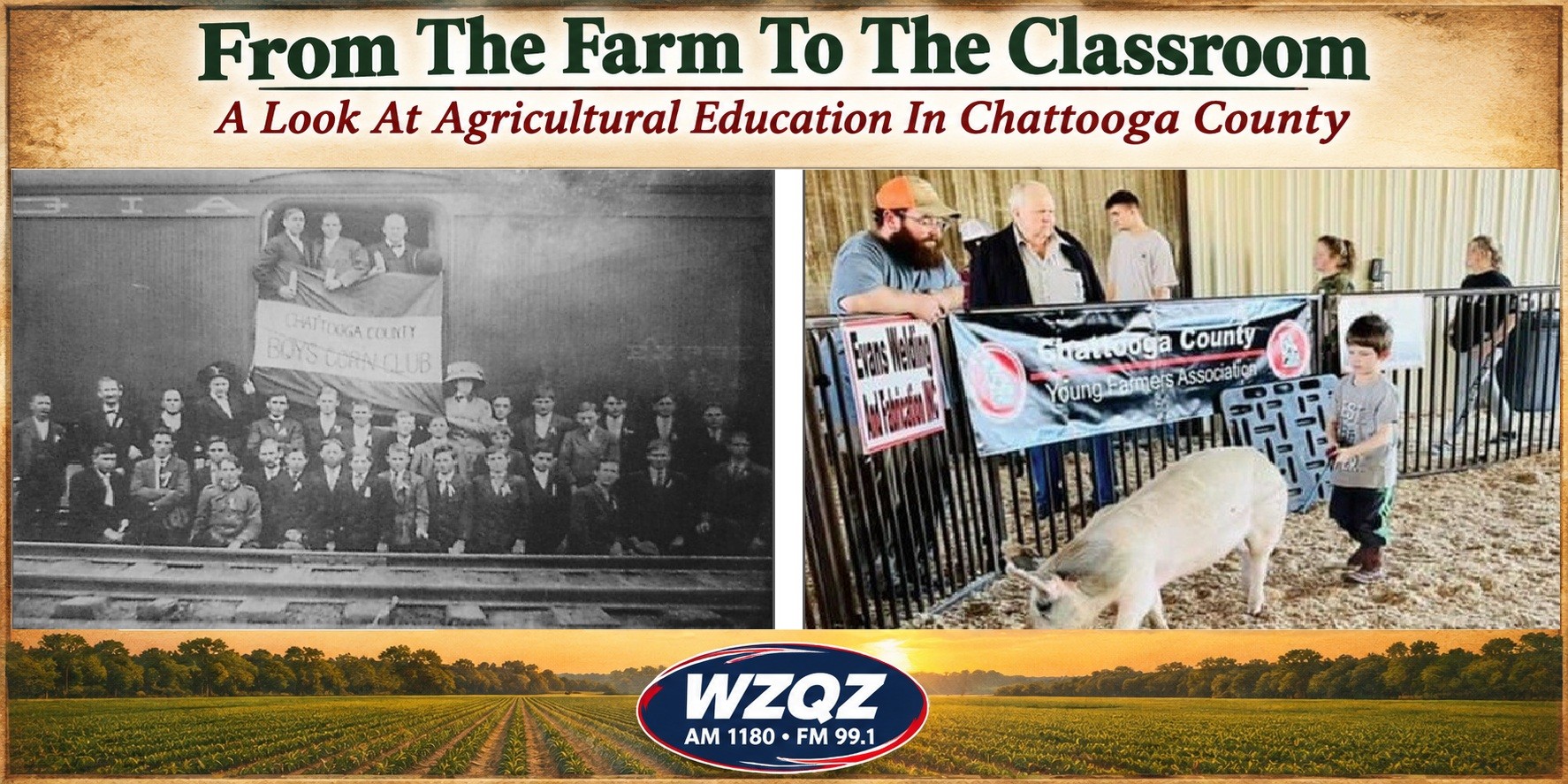
When Chattooga County students bring their hogs into the show ring this evening, they will be continuing a tradition of agricultural education that stretches back more than a century.
Long before Future Farmers of America chapters, 4-H livestock projects, and organized agricultural classes became familiar parts of school life, farming was central to Chattooga County’s economy. Young people learned much of what they knew about agriculture by working alongside their parents and grandparents, tending crops, caring for livestock, and helping operate family farms.
During the nineteenth century, cotton dominated much of the county’s agricultural economy. By the early 1900s, however, farmers were being encouraged to diversify. Peach orchards became a major industry, particularly around Menlo and Summerville. According to research preserved by the Chattooga County Historical Society, Menlo shipped between 500 and 700 railroad cars of peaches in 1906, while Summerville shipped another 350.
As farming methods changed, so did the ways young people learned about agriculture.
One of the earliest organized efforts came through the Boys’ Corn Clubs and Girls’ Tomato and Canning Clubs, which helped lay the foundation for the modern 4-H program.
Georgia’s first Boys’ Corn Club was organized in Newton County in 1904, while girls’ tomato and canning clubs began in Hancock County in 1906. These programs encouraged young people to learn improved farming, gardening, and food preservation methods through hands-on projects and competitions.
According to the Chattooga County Historical Society, Chattooga County organized its own Corn Club in 1910. A surviving photograph from around that time shows members of the Chattooga Boys Corn Club, providing a glimpse into one of the county’s earliest organized agricultural education programs.
These early clubs helped establish a tradition of learning by doing that would become central to agricultural education for generations.
A major turning point came in 1917 with passage of the Smith-Hughes Act, federal legislation named for two Georgians, Senator Hoke Smith and Congressman Dudley Hughes. The law provided support for vocational agriculture instruction in public schools, helping establish the classroom and hands-on training system that would become familiar to generations of students.
Future Farmers of America was established nationally in 1928, followed by the Georgia FFA Association in 1929. The organization combined agricultural instruction with leadership training, public speaking, competitions, and supervised farming projects.
By the middle of the twentieth century, vocational agriculture students across Georgia were learning about livestock production, crop management, farm machinery, soil conservation, and the business of farming.
A Georgia Department of Education publication from 1953 described a statewide FFA pig-chain program that began in 1944. Students received young breeding hogs and returned offspring from their first litters so other students could participate. The program demonstrated how agricultural education could provide practical experience while helping young people begin building their own farming operations.
Agricultural education also faced changing circumstances in Chattooga County.
As textile manufacturing and other industries became increasingly important to the local economy, fewer residents depended primarily on farming for their livelihoods. The question of agriculture’s place in public education was significant enough that a November 2, 1960, edition of The Summerville News carried an article titled “Does Chattooga Need Agricultural Education?”
By 1960, manufacturing employed a much larger share of the county’s workforce than farming. Nevertheless, agricultural education remained relevant not only to those planning to become farmers, but also to students interested in machinery, animal science, business management, and other practical skills.
Another important chapter came with the development of Young Farmer education. Georgia began its Young Farmer instructional program in 1951, providing continuing agricultural education for people already engaged in farming. The Georgia Young Farmers Association was organized in 1971.
Chattooga County’s Young Farmers program has its own longstanding history, dating to around 1970, and has become an important supporter of agricultural education and community activities.
The program continues to receive recognition. Earlier this year, Chattooga County Young Farmers was named the Georgia Vocational Agriculture Teachers Association’s Outstanding Post-Secondary Program.
Meanwhile, agricultural education has expanded far beyond traditional farming.
Through the University of Georgia Cooperative Extension Service, Chattooga County 4-H has introduced students to subjects ranging from plant science and food production to agricultural technology and leadership development. One local agriculture-awareness initiative reached hundreds of students and helped Lyerly Elementary School earn the Governor’s Agriculture Awareness Award.
Today, FFA, 4-H, and Young Farmers programs continue connecting classroom instruction with practical experience.
One of the clearest examples is the annual Chattooga County Pig Project. Participating students receive hogs during the summer and spend months feeding, caring for, and preparing their animals for exhibition and sale.
The program teaches responsibility, animal husbandry, financial management, and the relationship between agricultural production and the marketplace.
That work will be on display this evening when the Chattooga County FFA and 4-H Pig Show and Auction takes place at the Chattooga County Agricultural Center in Summerville, beginning at 7 PM.
The event is coordinated with support from the Chattooga County Young Farmers Association and provides an opportunity for the public to support local students by purchasing the hogs they have raised.
For generations, agricultural education has helped Chattooga County young people develop skills that reach beyond the farm.
And while the equipment, technology, and agricultural economy have changed dramatically since the days when cotton and peach orchards dominated the local landscape, the principle remains much the same: some of life’s most valuable lessons are learned by doing.
Sources
-
Chattooga County Historical Society — A Century of Chattooga County Fairs — Chattooga County Corn Club established in 1910 and its connection to the county fair.
-
Chattooga County Historical Society — Photo Archive — photograph of the Chattooga Boys Corn Club, circa 1910.
-
University of Georgia Cooperative Extension — Historical Timeline — origins of Georgia’s Boys’ Corn Clubs and Girls’ Tomato and Canning Clubs.
-
Georgia Department of Education — 1910 Annual Report — early agricultural demonstration clubs and their educational purposes.
-
Georgia FFA — Young Farmer Program — development of Young Farmer education.
-
UGA Cooperative Extension — Chattooga County 4-H — current local youth agricultural education.
-
Chattooga County Agricultural Fair — Livestock Programs — details of the 2026 Pig Project and November 9 show and auction.
Comments