








Most boat owners in Chattooga County will not receive a tax bill in 2026 following a change in state law that increased the exemption on boat accounts.

Most boat owners in Chattooga County will not receive a tax bill in 2026 following a change in state law that increased the exemption on boat accounts.

The Georgia Department of Natural Resources’ Wildlife Resources Division has released its 2026 Wildlife Management Area dove field forecast to help hunters prepare for the upcoming season.
The forecast was compiled following months of preparation by Game Management staff and provides information about field conditions at participating WMAs across Georgia. DNR officials emphasize that the ratings describe only the condition of each field and are not predictions of dove numbers or hunting success.
Hunters can use the forecast to review familiar hunting areas or consider visiting a new location this season.
Many WMA dove fields are available only through quota hunts. Hunters interested in those locations must submit their applications through GoOutdoorsGeorgia.com by August 15.
The complete forecast and additional dove-hunting information are available through the Georgia Wildlife Resources Division.
View the 2026 WMA Dove Field Forecast here  https://georgiawildlife.com/hunting/dove

Queen City Lake Beach in LaFayette will remain closed into next week as city officials continue investigating elevated E. coli levels in the water.
The City of LaFayette says daily testing has been conducted in an effort to determine the source of the contamination. While E. coli levels remain elevated, officials say the testing patterns have been inconclusive. The city is expanding the testing area to collect additional data and develop a clearer picture of the problem.
City officials are also working with the Georgia Department of Natural Resources for guidance concerning the non-native duck population around the lake, which may be contributing to the elevated bacteria levels.
Residents have also reported a sewer leak located some distance from the shoreline. The line is privately owned, and the city says the organization responsible for it has begun making repairs. That work is expected to be completed in the coming weeks.
Officials say they do not want to draw conclusions before the testing is complete and will continue collecting data while the beach remains closed.

Governor Brian Kemp has officially proclaimed August 2026 as Shooting Sports Month in Georgia, recognizing the state’s long-standing hunting traditions, recreational shooting opportunities, and the economic impact of the industry. The proclamation encourages Georgians of all experience levels to safely enjoy shooting sports throughout the month.
The Georgia Department of Natural Resources’ Wildlife Resources Division is encouraging residents to visit one of the state’s more than 45 public archery and shooting ranges, many of which are located on Wildlife Management Areas and Public Fishing Areas. The agency also promotes firearm safety training and responsible participation in shooting sports.
According to DNR, Georgia’s shooting sports and hunting industry contributed an estimated $2.7 billion to the state’s economy in 2024 and supports nearly 11,000 jobs. In addition, Georgia received more than $19.2 million in federal wildlife conservation funding in 2025 through the Pittman-Robertson Act, which is funded by excise taxes on firearms, ammunition, and archery equipment. Those funds help support wildlife management, habitat conservation, hunter education, and public shooting ranges across the state.
The proclamation highlights the role hunters and shooting sports enthusiasts play in conservation while encouraging safe, responsible firearm ownership and recreation throughout the month of August.

The Georgia Department of Natural Resources’ Wildlife Resources Division has released the 2026-2027 Georgia Hunting and Fishing Regulations and Seasons Guide, giving hunters and anglers an updated resource ahead of the upcoming outdoor seasons.

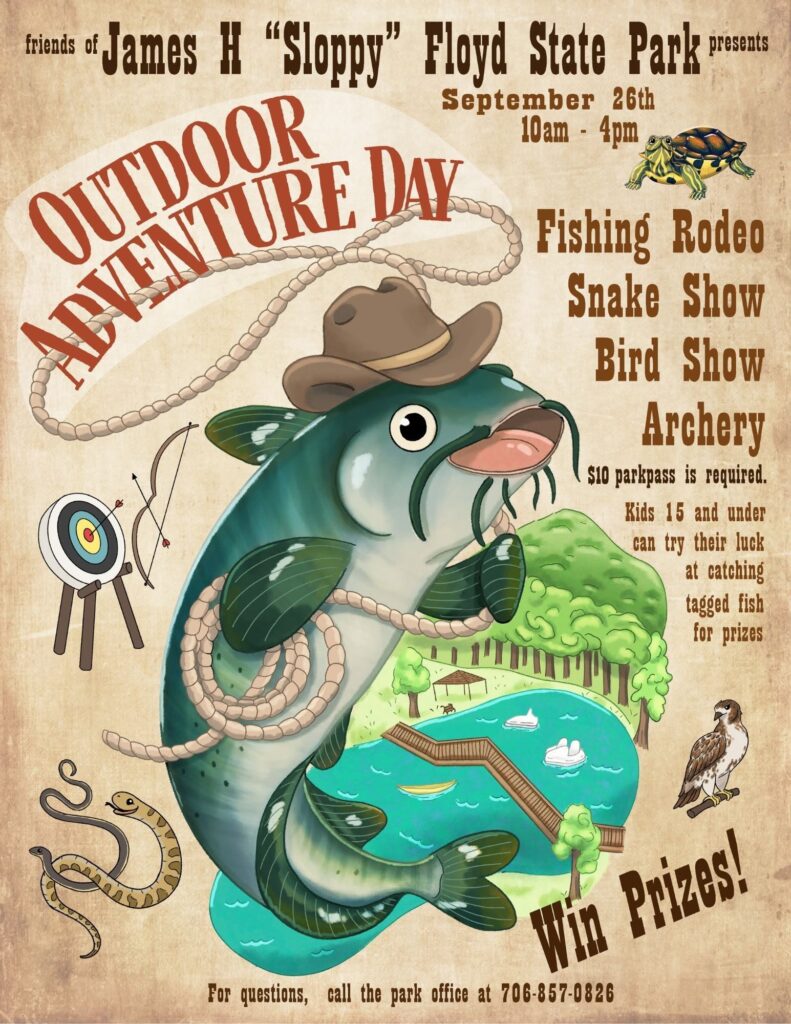
James H. “Sloppy” Floyd State Park is inviting outdoor enthusiasts to take part in two ranger-led programs on Saturday, July 18, offering opportunities to learn about the natural world during both the day and night.
The day begins with the Cloud Spotters program at 10 a.m., where participants will create a cloud spotter craft before hiking to the Lower Lake Dam to learn about different cloud formations and Earth’s weather systems. Guests are encouraged to bring a blanket, sunglasses and plenty of water. The program costs $3 per person, and a $10 park pass is also required.
Later that evening at 8 p.m., the park will host a Cold-Blooded Critters Night Hike along the Upper Lake Trail. Rangers will introduce participants to reptiles, amphibians and other cold-blooded animals while discussing their habitats, diets and survival strategies. Participants should wear comfortable hiking shoes and bring water. The night hike is also $3 per person, with a $10 park pass required.
Advance registration is required for both programs. To register or for more information, call the park office at 706-857-0826.

Berry College and the Georgia Department of Natural Resources have been awarded nearly $750,000 to restore thousands of acres of longleaf pine habitat in Northwest Georgia.
The project is supported by a $387,100 grant from the National Fish and Wildlife Foundation, with matching funds bringing the total investment to nearly $750,000.
The grant was secured by Dr. Adrienne Ernst, director of the Berry College Longleaf Pine Project, along with collaborators Carlee Steppe and Allison Melcher of the Georgia Department of Natural Resources’ Wildlife Resources Division.
The funding will be used to restore calcareous flatwoods and montane longleaf pine habitats at Berry College and nearby Georgia DNR Wildlife Management Areas. The project also aims to help recover Mohr’s Barbara’s button, a federally threatened plant species found in the flatwoods.
Officials say more than 3,000 acres will be restored and managed through prescribed burning, invasive species control, and targeted habitat improvements. The team will also develop a 50-year management plan to guide long-term conservation efforts across the landscape.

Georgia’s bald eagle population continues to thrive, according to the Georgia Department of Natural Resources’ annual nesting survey, which found nesting success well above long-term averages despite surveying fewer areas than usual this year.

Anyone planning a trip to the Georgia coast this summer may want to check beach conditions before heading into the water.
State officials have identified 15 miles of beachfront on Tybee Island, St. Simons Island, and Jekyll Island where elevated levels of enterococci, a type of fecal bacteria, have exceeded recreational water quality standards. The affected beach segments have been classified as “not supporting” recreational use under the Clean Water Act.
According to the Georgia Department of Natural Resources, enterococci bacteria can originate from wastewater, failing septic systems, stormwater runoff, wildlife, and pet waste. While the bacteria itself is used as an indicator, elevated levels may signal the presence of other disease-causing organisms that can increase the risk of illness for swimmers.
State officials are working to develop cleanup plans for the affected waters, and public comments on those plans are being accepted through July 16. Before visiting Georgia’s beaches, officials recommend checking the latest advisories through the Georgia Healthy Beaches program

Georgia wildlife officials are asking residents to be on the lookout for a large invasive lizard that poses a threat to native wildlife.