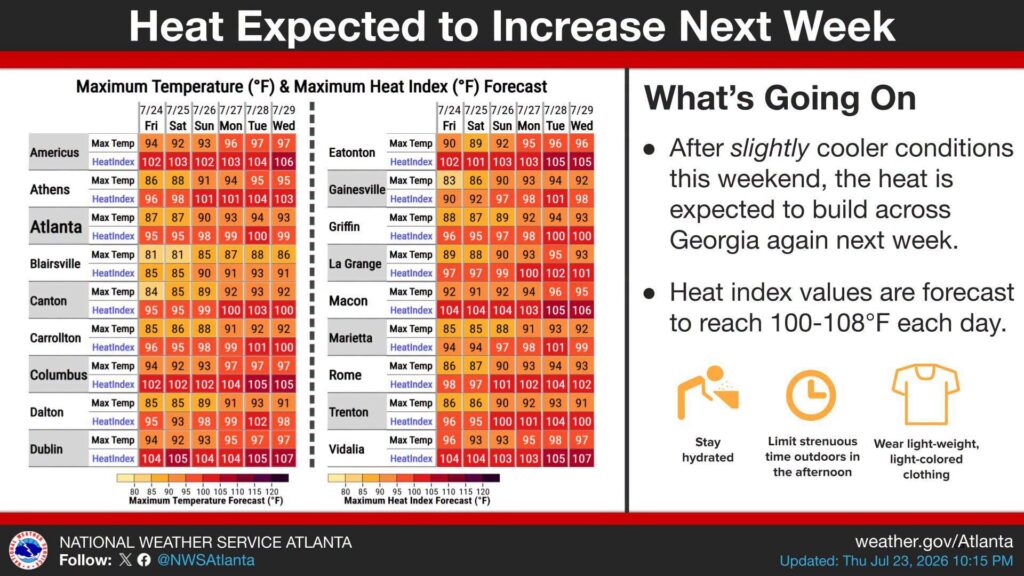
Those planning to celebrate Independence Day outdoors across Chattooga County and Northwest Georgia should prepare for another day of dangerous heat, with only a slight chance of an afternoon thunderstorm.
Today will be sunny and very hot with a high near 96 degrees. Heat index values are expected to climb as high as 102 degrees during the afternoon. While an isolated shower or thunderstorm could develop after 2 p.m., mainly along the Alabama state line and in parts of far northwest Georgia, most communities are expected to remain dry through much of the day. A few additional thunderstorms will be possible Saturday evening before skies become partly cloudy overnight.
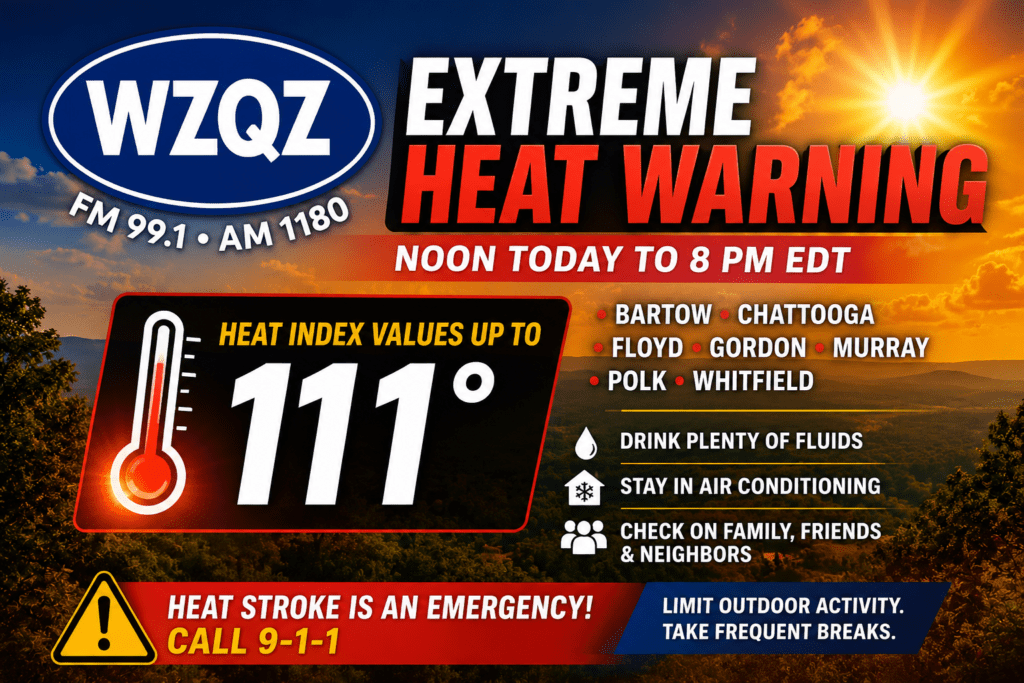
The National Weather Service says heat remains the biggest concern. “Feels like” temperatures are expected to exceed 90 degrees by around 10 a.m. and may not fall below that level until nearly 11 p.m., making it uncomfortably hot even after sunset. Anyone attending parades, cookouts, ballgames, fireworks displays, or other outdoor events should drink plenty of water, take frequent breaks in the shade or air conditioning, wear light-colored clothing, and check on children, older adults, and pets.
Rain chances increase beginning Sunday as the weather pattern becomes more typical for early July. Afternoon and evening showers and thunderstorms are expected Sunday through at least Friday, with daily rain chances ranging from 40 to 60 percent. High temperatures will ease slightly into the lower 90s by early next week, but humidity will keep heat index values in the upper 90s to around 100 degrees each afternoon.
Anyone spending time outdoors over the holiday weekend should continue to monitor the forecast, especially if thunderstorms develop later in the weekend.
Independence Day
A 20 percent chance of showers and thunderstorms after 2pm. Sunny, with a high near 96. Heat index values as high as 102. Calm wind.
Saturday Night
A 30 percent chance of showers and thunderstorms, mainly before midnight. Partly cloudy, with a low around 74. Calm wind.
Sunday
A slight chance of showers and thunderstorms before 2pm, then showers likely and possibly a thunderstorm between 2pm and 5pm, then showers and thunderstorms likely after 5pm. Mostly sunny, with a high near 95. Heat index values as high as 101. Calm wind becoming southwest around 5 mph. Chance of precipitation is 60%.
Sunday Night
Showers and thunderstorms likely, mainly before 8pm. Partly cloudy, with a low around 73. Calm wind. Chance of precipitation is 60%.
Monday
Showers and thunderstorms likely, mainly after 2pm. Mostly sunny, with a high near 92. Chance of precipitation is 60%.
Monday Night
Showers and thunderstorms likely before 2am, then a chance of showers. Partly cloudy, with a low around 72. Chance of precipitation is 60%.
Tuesday
A chance of showers, then showers and thunderstorms likely after 8am. Mostly sunny, with a high near 90. Chance of precipitation is 60%.
Tuesday Night
Showers and thunderstorms likely, mainly before 8pm. Partly cloudy, with a low around 72. Chance of precipitation is 60%.
Wednesday
A 40 percent chance of showers and thunderstorms, mainly after 2pm. Mostly sunny, with a high near 90.
Wednesday Night
A 30 percent chance of showers and thunderstorms. Partly cloudy, with a low around 72.
Thursday
A 40 percent chance of showers and thunderstorms. Mostly sunny, with a high near 91.
Thursday Night
A 30 percent chance of showers and thunderstorms. Partly cloudy, with a low around 72.
Friday
A 50 percent chance of showers and thunderstorms. Mostly sunny, with a high near 91.