









Drivers across Chattooga County and Northwest Georgia are paying considerably more at the pump this week, with regular gasoline now above $4 per gallon throughout much of the area.
Drivers across Chattooga County and Northwest Georgia are paying considerably more at the pump this week, with regular gasoline now above $4 per gallon throughout much of the area.

North Georgia Electric Membership Corporation customers who still receive their monthly electric bill through the mail will soon have to pay extra for that service.
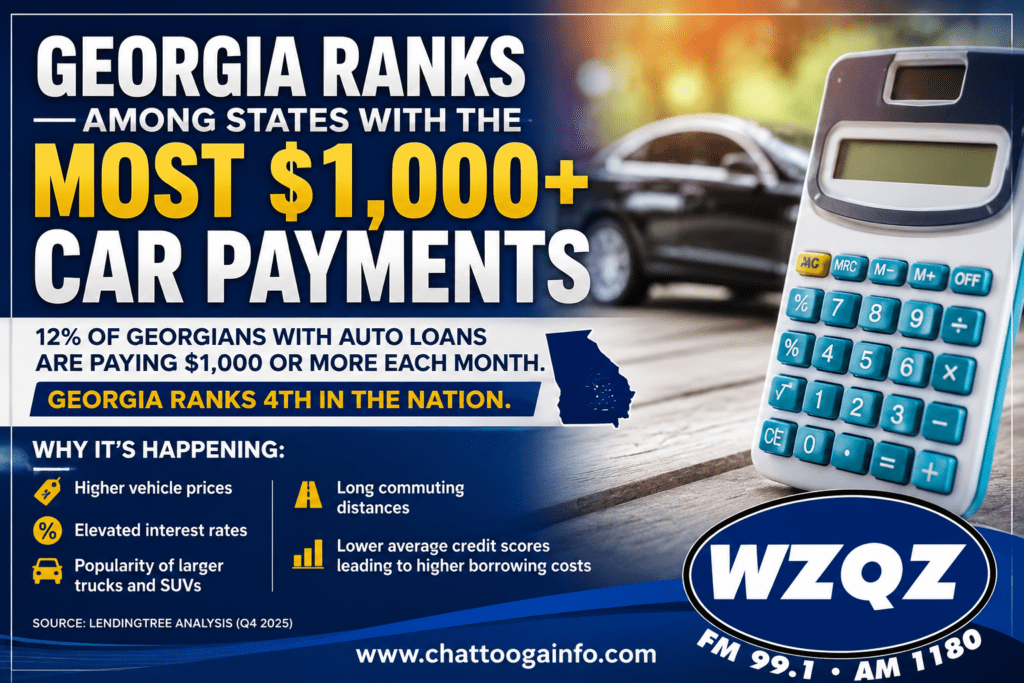
A growing number of Georgia drivers are making car payments of $1,000 or more each month, according to a new LendingTree analysis, placing Georgia fourth in the nation for borrowers carrying four-figure auto loan payments.
The study found that 12% of Georgians with active auto loans have at least one monthly payment of $1,000 or more. Only Texas, Alaska and Wyoming ranked higher. Nationwide, the figure is 9.6%. The analysis was based on approximately 180,000 anonymized credit reports from the fourth quarter of 2025.
Consumer finance experts say several factors are driving the trend in Georgia, including higher vehicle prices, elevated interest rates, the popularity of larger trucks and SUVs, long commuting distances and lower average credit scores, which can result in higher borrowing costs.
LendingTree Chief Consumer Finance Analyst Matt Schulz cautioned that qualifying for a large auto loan does not necessarily mean it’s affordable. He recommends buyers focus on the total cost of the vehicle rather than just the monthly payment, avoid unnecessarily long loan terms and purchase less vehicle than they think they can afford whenever possible.
After several weeks of declining fuel prices, Georgia motorists are seeing a slight increase at the pump as higher crude oil prices and strong summer travel demand begin to push gasoline prices upward.

Mailing a letter will soon cost a little more as the U.S. Postal Service prepares to increase the price of a First-Class Forever stamp from 78 cents to 82 cents beginning Sunday, July 12.
Georgia households are paying significantly more to keep the lights on than they were just six years ago, as a series of rate increases and higher energy costs continue to push electric bills upward.
Many Georgia Power customers may have noticed that electric bills remain high this summer, even though the utility recently lowered the fuel portion of its rates.
According to WABE, the biggest reason is increased summer electricity use. As temperatures climb, air conditioners run longer and harder, driving up the amount of electricity households consume. At the same time, Georgia Power’s higher seasonal summer rates take effect, meaning customers pay more for electricity during the months when demand is greatest.
Although the Georgia Public Service Commission approved a reduction in Georgia Power’s fuel costs that lowered the average residential bill by about $4 per month beginning in June, those savings are often outweighed by increased air conditioning use and higher summer rates.
Georgia Power recommends several ways to reduce bills, including raising the thermostat by one degree, using a programmable thermostat, replacing HVAC filters regularly, sealing air leaks around doors and windows, and taking advantage of free home energy audits and available rebates for energy-efficient improvements. Consumer advocates also encourage customers to carefully review optional billing plans before switching, as some may cost more over time depending on energy usage.
Georgia drivers are getting some welcome relief at the pump just as one of the busiest travel periods of the year approaches.

Cybersecurity experts are warning consumers about a growing phishing scam that uses digital calendar invitations to trick victims into revealing personal information, financial details and account credentials.

Drivers in Chattooga County continue to face car insurance rates that closely mirror Georgia’s already high statewide averages.